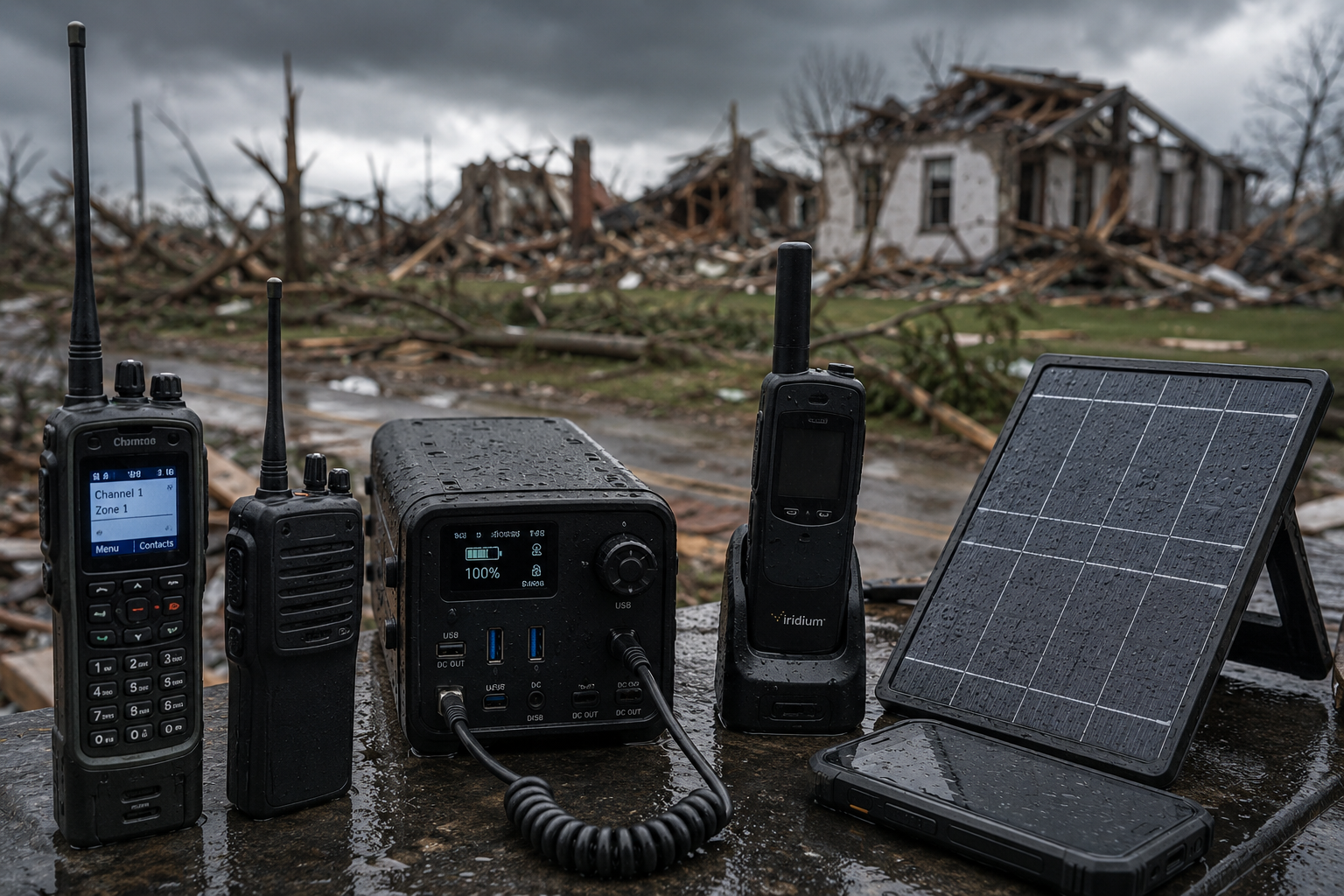
When a tornado warning sounds at 2 AM, your phone battery is dead, the power is out, and cell towers are overloaded — there is exactly one device that will give you the information you need to survive.
A hand crank emergency weather radio.
Every disaster scenario your household might face — hurricanes, tornadoes, floods, heat waves, wildfires, ice storms, and grid-down events — has one thing in common. Official emergency alerts from the National Weather Service are broadcast continuously on NOAA weather radio frequencies throughout every event, regardless of whether cell networks, internet, or commercial broadcast stations are functioning.
A hand crank emergency radio receives those alerts using nothing but the power your hand generates. No batteries to die. No grid power required. No cellular signal needed. Just reliable, life-saving information available exactly when every other communication system has failed.
This guide covers the best hand crank emergency radios available in 2026, what features actually matter versus marketing noise, and exactly how to set yours up before an emergency strikes.
Why a Dedicated Emergency Radio Belongs in Every Preparedness Kit
Smartphones have replaced dedicated radios for most people — creating a dangerous single point of failure in your emergency communication plan.
During major disasters, three things consistently happen to cell networks simultaneously. Towers lose power and switch to backup generators with limited fuel. Millions attempt calls and texts simultaneously, overwhelming bandwidth. And physical infrastructure sustains damage that takes days to repair.
NOAA weather radio operates on seven dedicated frequencies broadcast from over 1,000 transmitter sites covering 99% of the U.S. population. These frequencies operate independently of cell networks, internet infrastructure, and commercial broadcast systems. When everything else fails, NOAA weather radio keeps broadcasting.
A hand crank radio adds a second layer of resilience — the ability to generate your own power when batteries are exhausted and grid electricity is unavailable.
Read our Tornado Preparedness Guide (2026) and Hurricane Preparedness Guide (2026) to understand exactly how critical real-time weather alerts are during active disaster events.
What Features Actually Matter in an Emergency Radio
The emergency radio market is cluttered with products that look impressive on paper but fail when it counts. These are the features that genuinely matter.
NOAA Weather Alert Reception — Non-negotiable. Your radio must receive all seven NOAA weather radio frequencies and ideally support SAME (Specific Area Message Encoding) alerts — which allow you to program the radio to alert only for your specific county rather than the entire broadcast region.
SAME Alert Programming — Without SAME, your radio alerts for every county in a multi-state broadcast area. With SAME, it alerts only when your specific county is affected. The difference between a useful alert tool and an annoying noise machine.
Multiple Power Sources — The best emergency radios offer at least three power input methods — hand crank generation, solar panel charging, and standard battery backup. Each method covers a scenario where the others are unavailable.
AM/FM Reception — Local AM and FM stations often provide the most detailed, localized emergency information during events. NOAA covers national alerts but local stations cover road closures, shelter locations, and community-specific updates.
USB Phone Charging — A radio that charges your phone extends the value of every crank session dramatically. Phone charging capability turns your radio into a dual-purpose survival tool.
Flashlight and SOS Beacon — Built-in LED illumination eliminates the need for a separate flashlight during power outages. An SOS strobe function provides emergency signaling capability.
Durability and Water Resistance — Emergency radios get used in emergency conditions. A water-resistant housing protects the device during rain, flooding, and humid post-storm environments.
Top 5 Best Hand Crank Emergency Radios (2026)
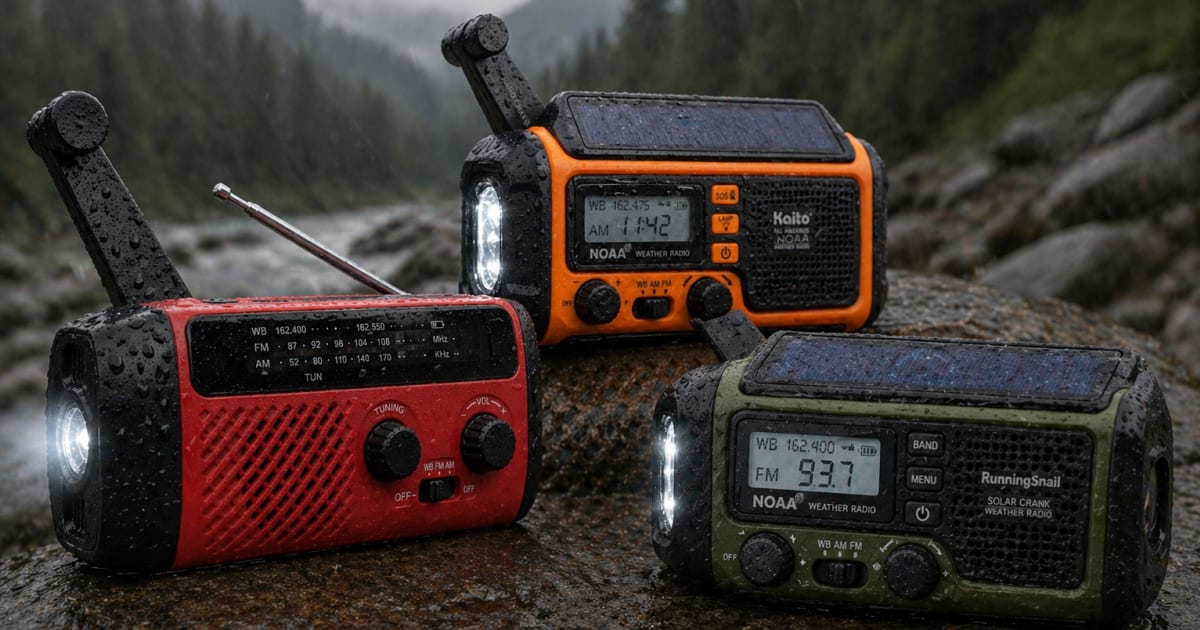
1. Kaito KA500 — Best Overall Hand Crank Emergency Radio

Best for: Home preparedness kits, bug-out bags, all-hazard emergency coverage
The Kaito KA500 has earned its reputation as the benchmark hand crank emergency radio for serious preparedness households. Five power sources — hand crank, solar panel, AA batteries, USB charging, and a built-in rechargeable battery — make it the most versatile power-independent radio available at any price point. SAME alert programming, reception across all seven NOAA frequencies, and AM/FM/shortwave coverage combine with a built-in LED flashlight, reading lamp, and phone charging port.
Key features:
- Five independent power sources — unmatched redundancy
- SAME county-specific alert programming
- All 7 NOAA weather frequencies
- AM/FM/shortwave reception
- Built-in LED flashlight and reading lamp
- USB phone charging output
- Compact enough for bug-out bag storage
👉 Check Price on Amazon — Kaito KA500 5-Way Powered Emergency Radio
2. Midland ER310 — Best Emergency Radio for Home Use
Best for: Households prioritizing alert reliability and ease of use
The Midland ER310 is purpose-built for home emergency preparedness with a focus on alert reliability over feature quantity. Its SAME alert system is among the most responsive available — waking from standby mode within seconds of a county-specific NWS alert. The ER310's larger speaker delivers significantly clearer audio than compact competitors, making alerts audible across a room without being held directly.
Key features:
- SAME alert with instant wake-from-standby response
- Hand crank, solar, and USB-C charging
- Large high-clarity speaker
- USB phone charging port
- LED flashlight with SOS strobe
- Compact carry handle for portable use
👉 Check Price on Amazon — Midland ER310 Emergency Crank Weather Radio
3. RunningSnail MD-090P — Best Budget Hand Crank Radio
Best for: Budget-conscious households, secondary kit radios, gift preparedness kits
The RunningSnail MD-090P delivers genuine emergency radio capability at the lowest price point of any reliable option in this guide. NOAA weather reception, hand crank charging, solar panel, and built-in flashlight cover the core emergency use case without unnecessary features that inflate cost. An ideal choice for households building their first preparedness kit or stocking multiple locations.
Key features:
- NOAA weather and AM/FM reception
- Hand crank and solar charging
- Built-in LED flashlight
- USB phone charging port
- Compact and lightweight
- 2000mAh internal battery
👉 Check Price on Amazon — RunningSnail MD-090P Emergency Weather Radio
4. Eton FRX5-BT — Best Premium Emergency Radio
Best for: Tech-forward households, those wanting Bluetooth integration, premium home kit
The Eton FRX5-BT represents the premium tier of hand crank emergency radio capability. Bluetooth connectivity allows wireless speaker use for everyday music while maintaining full NOAA alert capability. The digital display provides clear frequency readout and alert status. A larger internal battery bank delivers more phone charging capacity than any other option in this guide.
Key features:
- Bluetooth speaker functionality for everyday use
- SAME alert programming with digital display
- Hand crank, solar, and USB charging
- Largest phone charging capacity in category
- AM/FM/NOAA/shortwave reception
- LED flashlight and red emergency beacon
👉 Check Price on Amazon — Eton FRX5-BT Emergency Weather Radio
5. Midland WR400 — Best Tabletop Emergency Alert Radio
Best for: Home base alert station, bedroom nightstand, family common areas
The Midland WR400 is not a hand crank portable — it is a plugged-in tabletop alert station designed to monitor NOAA frequencies continuously and wake your household with an alarm when a county-specific alert is issued. Think of it as a smoke detector for weather emergencies. Paired with a portable hand crank radio, it creates a complete two-layer alert system — continuous monitoring at home plus portable capability when away or during outages.
Key features:
- Continuous NOAA monitoring while plugged in
- SAME county-specific programming
- Battery backup for alert function during outages
- Alarm loud enough to wake sleeping household members
- Color-coded alert display by hazard type
- Ideal as permanent home base station
👉 Check Price on Amazon — Midland WR400 Tabletop Weather Alert Radio
Emergency Radio Comparison Table
| Radio | Hand Crank | Solar | SAME Alerts | Phone Charging | Best For | |---|---|---|---|---|---| | Kaito KA500 | ✅ | ✅ | ✅ | ✅ | Best overall — 5 power sources | | Midland ER310 | ✅ | ✅ | ✅ | ✅ | Home use — best alert response | | RunningSnail MD-090P | ✅ | ✅ | ✅ | ✅ | Best budget option | | Eton FRX5-BT | ✅ | ✅ | ✅ | ✅ | Premium — Bluetooth enabled | | Midland WR400 | ❌ | ❌ | ✅ | ❌ | Tabletop home base station |
How to Set Up Your Emergency Radio Before a Disaster
Unboxing your radio during an emergency is too late. Follow these steps now while conditions are calm.
Step 1 — Program Your SAME County Code Every SAME-capable radio requires you to enter your specific county's FIPS code to filter alerts to your area. Find your county's code at the NOAA website. This takes two minutes and eliminates alert fatigue from neighboring county warnings.
Step 2 — Test All Power Sources Fully charge the internal battery via USB. Verify the hand crank charges the battery — typically 1 minute of cranking delivers 10 to 15 minutes of radio operation. Test the solar panel in direct sunlight. Confirm battery backup with fresh AA batteries if applicable.
Step 3 — Program Your Priority Frequencies Scan through all seven NOAA frequencies and identify the strongest signal in your area. Set this as your primary channel. Program one backup frequency in case your primary transmitter loses power during a regional event.
Step 4 — Store in Your Kit Your emergency radio belongs inside your designated emergency kit or shelter location — not in a junk drawer. During a tornado warning or hurricane evacuation, you need it in seconds. See our Flood Preparedness Guide (2026) and Heat Wave Survival Guide (2026) for complete emergency kit guidance.
Step 5 — Test Monthly Tune to your programmed NOAA frequency once a month. Replace AA backup batteries annually.
Which Radio Is Right for Your Household?
- Kaito KA500 — Maximum versatility, five power sources, handles every scenario from home use to bug-out bag carry
- Midland ER310 — Best home alert reliability, clearest audio, fastest alert wake response
- RunningSnail MD-090P — Best budget option, ideal for stocking multiple locations
- Eton FRX5-BT — Premium choice, doubles as a Bluetooth speaker for everyday use
- Midland WR400 — Best permanently installed home alert station for nighttime warnings
Final Thoughts
A hand crank emergency radio makes every other tool in your preparedness kit more effective. Food storage, water supply, generators, and go-bags all depend on knowing what is happening outside — what the storm is doing, when it is safe to move, and what authorities are directing.
Without a reliable information source that operates independent of cell networks and grid power, you are managing an emergency blind.
Every household in the United States faces weather emergencies. A radio that costs less than a tank of gas provides life-saving information indefinitely — powered by nothing but your own hand when every other system has failed.
For a complete emergency preparedness strategy beyond emergency communication, read our full Complete Grid Down Survival Guide (2026), which covers food storage, backup power, water filtration, bug out bags, and long-term blackout survival.
Explore our complete Emergency Kits & Bundles and Shop All Survival Gear to build your full preparedness system today.
⚠️ Don't wait for the next warning to find out your radio isn't set up. Build your communication backup before the sirens sound.