Extreme heat kills more Americans every year than hurricanes, tornadoes, and floods combined.
That statistic surprises most people — because heat is invisible. There is no dramatic footage, no breaking news coverage, no evacuation orders. Heat simply builds, quietly and relentlessly, until the human body can no longer regulate its core temperature. By the time symptoms become obvious, a medical emergency is already underway.
Heat waves are also becoming longer, more intense, and more frequent across every region of the United States — not just the desert Southwest. The Pacific Northwest, the Midwest, and the Northeast have all experienced record-breaking heat events in recent years that caught unprepared communities completely off guard.
This guide covers everything your household needs to survive a heat wave safely — the right gear, the right plan, and the warning signs that separate discomfort from danger.
What Makes a Heat Wave Dangerous
A heat wave is formally defined as a period of abnormally high temperatures lasting two or more consecutive days. But the real danger is not the temperature number on the thermometer — it is the combination of heat, humidity, and duration.
Heat Index — The "feels like" temperature that accounts for humidity. When relative humidity is high, sweat cannot evaporate efficiently, eliminating your body's primary cooling mechanism. A 95°F day with 60% humidity feels like 114°F to your body.
Overnight Temperatures — The most dangerous heat waves are those where overnight temperatures stay above 80°F. Your body needs nighttime hours to recover from daytime heat stress. When nights stay hot, that recovery never happens and heat stress accumulates over multiple days.
Power Grid Stress — Heat waves drive air conditioning demand to extreme levels, straining the electrical grid to its breaking point. Rolling blackouts during peak heat events are increasingly common across multiple U.S. regions. Losing power during a heat wave transforms a hot home into a potentially lethal environment within hours.
Read our What Happens After Day 3 of a Power Outage guide to understand exactly how fast conditions deteriorate when power fails during extreme heat.

Heat-Related Illness — Know the Difference
Recognizing the progression from heat exhaustion to heat stroke is the most critical heat wave survival skill your household can develop.
Heat Cramps
The earliest warning sign. Painful muscle spasms — typically in the legs, arms, or abdomen — caused by fluid and electrolyte loss through heavy sweating.
Response: Move to a cool location immediately. Drink water or an electrolyte beverage. Rest and do not resume strenuous activity.
Heat Exhaustion
A serious condition requiring immediate action. Symptoms include heavy sweating, cool and pale skin, fast and weak pulse, nausea, dizziness, headache, and fainting.
Response: Move to an air-conditioned space or the coolest available location. Apply cool wet cloths to skin. Sip water or electrolyte drinks slowly. If symptoms worsen or do not improve within 30 minutes, treat as heat stroke.
Heat Stroke
A life-threatening medical emergency. Body temperature reaches 103°F or above. Skin becomes hot, red, and dry — sweating stops entirely. Pulse becomes rapid and strong. Confusion, slurred speech, and loss of consciousness follow.
Response: Call emergency services immediately. Move the person to a cool location. Cool them rapidly using any available method — cold water immersion, ice packs to neck, armpits, and groin, cool wet sheets. Do not give fluids to an unconscious person.
For a complete breakdown of treating medical emergencies when help is delayed, read our Emergency First Aid When Help Is Delayed guide.
The Best Heat Wave Survival Gear (2026)
1. Portable Evaporative Air Cooler — Best Cooling Solution Without Central AC

Best for: Homes without central AC, rooms away from window AC units, garages and workshops
A portable evaporative air cooler — commonly called a swamp cooler — uses water evaporation to lower ambient air temperature by 15 to 25 degrees in dry climates. Unlike window AC units, they require no installation, draw a fraction of the electricity, and can run on a portable power station during grid outages.
Key features to look for:
- Minimum 3-gallon water tank for extended operation
- Built-in fan speeds — at least 3 settings
- Oscillating louvers for room coverage
- Compatible with standard power banks and portable stations
👉 Check Price on Amazon — Hessaire MC18M Portable Evaporative Cooler
2. Rechargeable Misting Fan — Best Personal Cooling Device
Best for: Outdoor use, power outages, sleeping comfort, personal cooling at any age
A rechargeable misting fan combines airflow with fine water mist to drop your personal temperature rapidly — delivering the equivalent of moving into a space several degrees cooler. Compact, portable, and USB rechargeable, this is the single most practical personal heat survival tool available.
Key features:
- USB-C rechargeable — works with any power bank
- Continuous mist mode plus fan-only mode
- Minimum 8-hour battery life on fan-only setting
- Adjustable mist output
👉 Check Price on Amazon — JISULIFE Handheld Misting Fan Rechargeable
3. Electrolyte Powder Packets — Most Critical Consumable Supply
Best for: Every household member — especially children, elderly, and anyone working outdoors
Dehydration during a heat wave is not just about water loss — it is about electrolyte loss. Drinking plain water without replacing sodium, potassium, and magnesium accelerates heat exhaustion rather than preventing it. Electrolyte powder packets dissolve instantly in any water source and provide complete rehydration far more effectively than water alone.
Stock minimum: 3 packets per person per day for a 14-day heat wave scenario.
👉 Check Price on Amazon — LMNT Zero Sugar Electrolyte Packets
4. Cooling Towels — Instant Temperature Drop for Any Situation
Best for: Outdoor workers, children playing outside, power outage cooling, elderly household members
Cooling towels use evaporative technology to drop surface temperature by up to 30 degrees when wet and applied to skin. Reusable, lightweight, and requiring only water to activate — they provide immediate relief during both outdoor heat exposure and indoor power outage situations.
👉 Check Price on Amazon — Mission Cooling Towel
5. Jackery Explorer 300 Portable Power Station — Best Power Backup for Heat Emergencies
Best for: Running fans, coolers, and phone charging during heat wave power outages
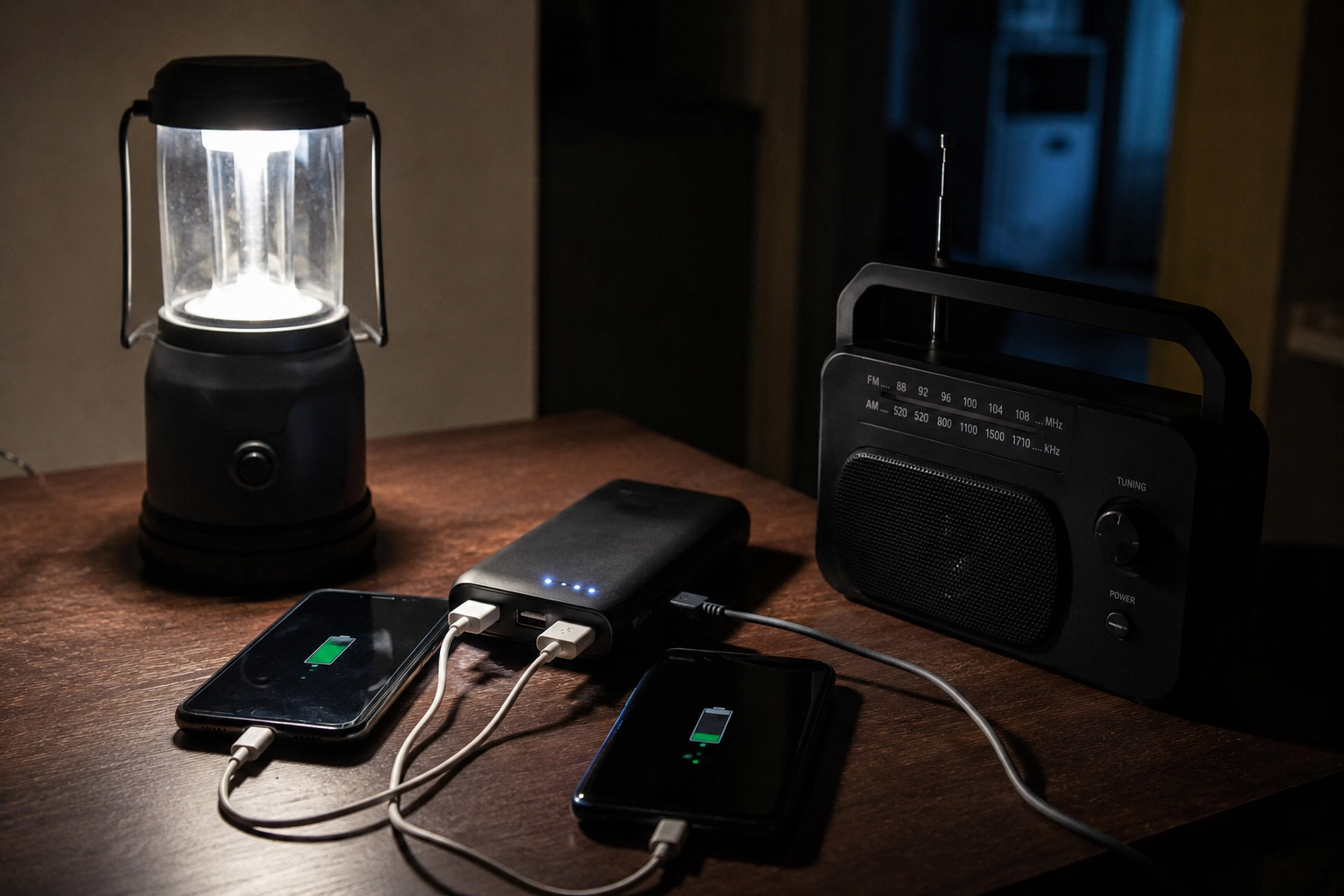
When the grid fails during a heat wave your cooling options disappear with it — unless you have backup power. The Jackery Explorer 300 delivers 293Wh of clean power capable of running a portable fan continuously for 15+ hours, charging all your devices, and powering a small evaporative cooler for several hours. Silent, safe for indoor use, and rechargeable via solar panel.
See our complete Best Solar Generators & Power Stations for Emergencies (2026) guide for a full comparison of backup power options.
👉 Check Price on Amazon — Jackery Explorer 300 Portable Power Station
6. Emergency Water Storage — Non-Negotiable Foundation
During heat waves, municipal water systems face extreme demand while heat-related infrastructure stress can disrupt supply. A stored water supply is your safety net when tap water becomes unavailable or unsafe.
Minimum target: One gallon per person per day — more in extreme heat where sweat loss is higher. A family of four needs a minimum of 28 gallons for a 7-day heat wave scenario.
See our Best Emergency Water Storage Solutions (2026) guide for complete storage container recommendations.
👉 Check Price on Amazon — WaterStorageCube 5.3 Gallon BPA-Free Water Container
Your Heat Wave Action Plan — Before, During, and After
Before a Heat Wave — Prepare Now
- Identify your coolest room — typically a north-facing interior room on the lowest floor. This becomes your household's safe room during peak heat hours.
- Stock electrolytes and water — before a heat event is forecast, not during. Store shelves empty fast when heat warnings are issued.
- Charge all devices and power banks — a full charge before the heat arrives gives you maximum resources if the grid fails.
- Identify your nearest cooling center — most municipalities open public cooling centers during heat emergencies. Know the location before you need it.
- Check on vulnerable neighbors — elderly residents and those without air conditioning are at extreme risk during prolonged heat events.
During a Heat Wave — Hour by Hour
- Stay indoors during peak hours — 10 AM to 6 PM represents the highest heat danger window. Limit outdoor exposure to early morning and after sunset.
- Close blinds and curtains on sun-facing windows — up to 30% of indoor heat gain enters through windows. Blackout curtains on south and west-facing windows make a measurable difference.
- Never leave children or pets in vehicles — interior car temperatures reach lethal levels within 10 minutes on a hot day.
- Eat light, cool meals — your body generates heat digesting heavy foods. Cold foods, fruits, and salads reduce internal heat production.
- Use the lowest floor — heat rises. The lowest floor of your home is always the coolest during a heat event.
After a Heat Wave
- Restock consumed supplies — replace electrolytes, water, and any cooling gear before the next heat event.
- Check your power station charge level — recharge via solar panel or wall outlet immediately after use.
- Inspect cooling equipment — clean evaporative cooler pads and check fan function before storing.
Who Is Most Vulnerable — Protect These Household Members First
Heat does not affect everyone equally. These groups face disproportionate risk during prolonged heat events and require additional protective measures.
Elderly adults (65+) — The body's ability to regulate temperature declines with age. Elderly individuals may not feel thirsty even when severely dehydrated. Check on elderly family members and neighbors multiple times daily during heat warnings.
Infants and young children — Children's bodies heat up three to five times faster than adults. Never rely on a child to self-report heat distress — monitor actively.
People with chronic conditions — Heart disease, kidney disease, diabetes, and respiratory conditions all increase heat vulnerability significantly.
Outdoor workers — Construction, landscaping, and agriculture workers face the highest occupational heat risk. Mandatory hydration schedules and shade breaks are essential.
Final Thoughts
Heat waves are the deadliest weather events in the United States — and the least prepared for.
The right gear, a stocked water supply, a backup power source, and a clear household action plan convert a potentially dangerous heat emergency into a manageable situation. None of it requires significant expense or expertise. It requires doing it before the heat arrives.
Summer heat warnings can escalate from forecast to emergency within 24 hours. The time to build your heat wave kit is today — not when the temperature alert hits your phone.
Explore our complete Emergency Kits & Bundles and Shop All Survival Gear to build your full summer preparedness system today.
⚠️ Heat wave season is here — don't wait. Every day without a plan is a risk. Build your kit before the temperature spikes.