Sixty-seven percent of American households own at least one pet. Yet when emergency management organizations survey disaster preparedness levels, pet owners consistently rank among the least prepared — not because they care less about their animals, but because the standard preparedness conversation almost never addresses the specific needs of pets during disasters.
The consequences show up in the data after every major event. Thousands of animals are lost, injured, or left behind during hurricanes, wildfires, floods, and evacuations every single year. Families that did not prepare for their pets face an impossible choice — leave an animal behind or risk their own safety trying to improvise solutions in the middle of a crisis.
Neither outcome is acceptable. And neither is necessary with the right preparation in place before an emergency strikes.
This guide covers everything your household needs to keep your pets safe during any emergency — the gear, the plan, and the steps that make the difference between a family that evacuates together and one that doesn't.
Why Pet Preparedness Is Different From Human Preparedness
Pets cannot communicate their needs during an emergency. They cannot tell you they are dehydrated, in pain, or on the verge of a stress-induced behavioral crisis. They cannot follow verbal instructions in chaotic environments or navigate to safety independently.
Stress physiology — Pets experience the same fight-or-flight response as humans but with less cognitive ability to override it. A dog that has never shown aggression may bite when injured or overwhelmed. A cat that has always been calm may become completely unmanageable in an unfamiliar shelter environment.
Environmental hazards — Post-disaster terrain is categorically more dangerous for animals. Broken glass, sharp metal, hot pavement, toxic flood water, and chemical spills all present serious injury risk to unprotected paws and skin.
Shelter requirements — Emergency shelters that accept pets almost universally require proof of current vaccinations, proper containment, and species-specific documentation. A family without these prepared in advance may find their pet refused entry to the only available shelter.
Temperature vulnerability — Both dogs and cats thermoregulate differently than humans. Heat stroke develops faster in animals during summer evacuations. Indoor pets have significantly less cold tolerance than their wild counterparts during winter outages.
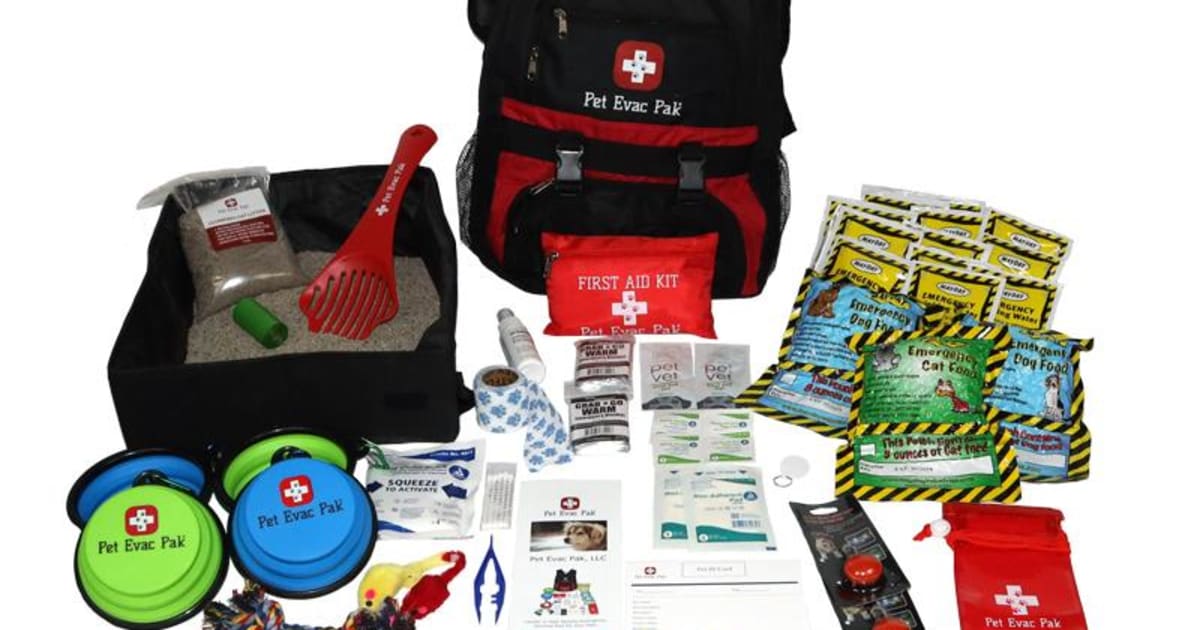
The Pet Emergency Kit — What Every Animal Owner Needs
A complete pet emergency kit addresses five core categories. Every item should be stored together in a dedicated bag that travels with your pet during any evacuation.
Medical
Your pet's medical supplies are the highest priority category in any emergency kit. Injuries during disaster evacuations are common — debris navigation, stress-related incidents, and the general physical demands of emergency movement all produce wounds that require immediate treatment when veterinary care is hours away.
Pet first aid kit — A dedicated pet first aid kit covers cuts, lacerations, burns, and minor trauma with species-appropriate supplies. Human first aid kits contain items that are toxic to animals — dedicated pet kits eliminate that risk entirely.
👉 Check Price on Amazon — Pet First Aid Kit Emergency Medical Kit
Styptic powder — Stops minor bleeding from broken nails and surface cuts instantly. One of the most-used items after any active evacuation scenario.
Tick removal kit — Outdoor evacuation routes expose pets to ticks rapidly. Proper removal tools eliminate the infection risk that improper technique creates.
Current medications — Maintain a minimum 30-day supply of any prescription medications your pet takes. Note the medication name, dosage, and prescribing veterinarian on a card stored inside your kit.
Containment and Transport
Getting your pet safely contained and transported during an emergency is the single most critical operational challenge pet owners face during rapid evacuation scenarios.
Soft sided pet carrier — Airline approved carriers that your pet is already familiar with reduce evacuation stress dramatically and meet the containment requirements of virtually all emergency shelters and transport options.
👉 Check Price on Amazon — Soft Sided Pet Carrier Airline Approved
Collapsible travel crate — Medium and large dogs require a dedicated crate at shelter destinations. A collapsible option that packs flat in your vehicle trunk ensures your dog has guaranteed shelter access regardless of the facility your family reaches.
Backup leash and collar — Store a dedicated backup set in your emergency kit. Primary leashes and collars are frequently lost or damaged during chaotic evacuations.
Food and Water
Standard pet food options — open bags of kibble and canned wet food — are impractical for emergency scenarios. Both spoil rapidly without refrigeration, are heavy and bulky for evacuation loads, and require preparation infrastructure that may not be available.
Freeze dried emergency dog or cat food — 25-year shelf life, 80% lighter than wet food, rehydrates in minutes with any water source. The only practical long-term emergency food solution for pets.
👉 Check Price on Amazon — Freeze Dried Emergency Dog Food 72-Hour Supply
Portable filtered pet water bottle — Municipal water supplies become contaminated or unavailable during floods and hurricanes. A filtered water bottle converts any available water source — streams, puddles, collected rainwater — into safe drinking water for your dog on the move.
Collapsible food and water bowls — Lightweight silicone bowls fold flat and add almost no weight or volume to your evacuation load.
Identification and Safety
Thousands of pets are permanently lost during every major disaster. Proper identification dramatically increases recovery rates when separation occurs.
GPS pet tracker — Real-time cellular location tracking that finds your pet in minutes regardless of how far they travel from the separation point. The single most important identification investment available for pet owners in high-risk disaster zones.
👉 Check Price on Amazon — GPS Pet Tracker Real Time Location
Waterproof ID tag — Deep engraved stainless steel with your name, phone number, and a secondary contact. Readable after days of flood submersion when standard painted tags have become illegible.
Pet life jacket — Floods are the most common disaster in the United States. Even strong swimmers drown in moving floodwater. A properly fitted life jacket keeps your pet's head above water automatically.
👉 Check Price on Amazon — Pet Life Jacket Emergency Flotation Vest
Reflective safety vest — Makes your dog visible from 500 feet in vehicle headlights during nighttime evacuations when street lighting is out across entire neighborhoods.
Stress and Anxiety Management
Behavioral emergencies are real emergencies. A panicked dog in an evacuation vehicle creates a dangerous distraction. A cat that refuses to enter its carrier costs critical minutes during a timed evacuation window.
Calming treats — Fast acting natural ingredient treats containing L-theanine and melatonin reduce the neurological stress response without sedation. Administer 30 to 45 minutes before anticipated stress triggers.
👉 Check Price on Amazon — Calming Treats for Dogs and Cats Emergency
Thundershirt anxiety wrap — Clinically proven in 80% of dogs to reduce anxiety through gentle sustained pressure. Works immediately without medication or prescription.
Calming pheromone spray — Synthetic pheromones sprayed inside your pet's carrier create a chemically familiar environment that reduces the stress of confinement and transport.
Your Pet Emergency Documentation
Emergency shelters and veterinary triage stations require documentation that most pet owners do not have readily accessible during rapid evacuation scenarios.
Store these records in a waterproof document sleeve inside your pet emergency kit:
- Current rabies vaccination certificate
- All core vaccine records
- Microchip registration certificate
- Recent photo of your pet with you — proof of ownership
- Complete medication list with dosages
- Known allergies and medical conditions
- Veterinarian contact information
- Emergency veterinary clinic locations along your evacuation routes
Without vaccination records your pet may be refused entry to emergency shelters entirely. One waterproof sleeve containing these documents eliminates that risk completely.
Explore our complete Pet Emergency Preparedness category for all the gear covered in this guide.
Building Your Pet Evacuation Plan
Gear without a plan fails during real emergencies. Every pet-owning household needs explicit answers to these questions before a disaster.
Where will your pet be confined during evacuation? Identify your carrier or crate location. Practice loading your pet in calm conditions until they enter voluntarily.
Who is responsible for your pet? Assign explicit pet responsibility to one specific adult during rapid evacuations. Ambiguity about who is grabbing the pet creates the conditions under which animals get left behind.
Where will your pet stay if you cannot return home? Identify pet-friendly hotels along your likely evacuation routes. Know the location of emergency pet-friendly shelters in your region before you need them.
What is your plan if your pet gets separated? GPS tracker plus waterproof ID tag plus microchip registration creates a three-layer identification system. Know exactly what steps to take immediately after separation.
For a complete family evacuation and communication plan that integrates your pets, see our Why Every Family Needs an Emergency Plan guide.

Disaster-Specific Pet Preparedness
Different disasters create different specific risks for pets. Tailor your preparation to the threats most likely in your region.
Hurricanes — Storm surge and flooding are the primary pet threats. Pet life jacket, waterproof ID, GPS tracker, and a confirmed evacuation destination that accepts pets are non-negotiable for coastal households. See our Hurricane Preparedness Guide for complete planning guidance.
Floods — Flash flooding gives minimal warning. Your pet carrier must be immediately accessible — not stored in a hard-to-reach location. Practice rapid loading from any room in your home. Read our Flood Preparedness Guide for complete flood safety planning.
Wildfires — Smoke inhalation affects pets faster than humans due to their smaller lung capacity and lower body position in smoke-filled air. Evacuate early — never wait until fire is visible. Dog boots protect paws during evacuation through ash and ember fields.
Extended Power Outages — Temperature extremes during summer and winter outages are the primary threat. Never leave pets in vehicles or unventilated spaces. Monitor for heat stress and hypothermia signs actively rather than waiting for the animal to show obvious distress.
Final Thoughts
Your pets cannot prepare for emergencies. They cannot pack their own supplies, research evacuation routes, or understand that the chaos surrounding them is temporary and survivable. That responsibility belongs entirely to you — and the time to accept it is before the emergency, not during it.
A complete pet emergency kit, a practiced evacuation plan, and current identification on every animal in your household costs less than a single veterinary visit and takes less than one afternoon to build.
Build it this week. Practice loading your pets into their carriers. Update their ID tags. Stock their emergency food. Know where you are taking them when you have to leave.
Your pets are counting on decisions you make today.
Explore our complete Pet Emergency Preparedness category and Emergency Kits & Bundles to build your full household preparedness system today.
⚠️ Your pets cannot prepare themselves — that's your job. Build your pet emergency kit today before the next disaster gives you no time to.