Apartment living comes with a preparedness problem that most emergency guides completely ignore.
Every standard piece of advice — buy a generator, store a month of water in the garage, install a whole-home backup battery — assumes you own a house with a yard, a garage, and unlimited storage space. For the 44 million American households living in apartments, that advice is useless.
Apartment dwellers face power outages just as frequently as homeowners — and often face them in worse conditions. High-rise buildings lose elevator access immediately. Electric stoves and ovens stop working. Building HVAC systems shut down, turning apartments into ovens in summer and freezers in winter. Hallways go dark. Security systems fail.
The good news is that apartment-specific emergency preparedness is entirely achievable — it simply requires a different approach. Compact gear, creative storage, and solutions that work within building rules and small square footage make the difference between being caught completely off guard and managing an outage with confidence.
This guide covers exactly how apartment dwellers prepare for power outages in 2026 — what to buy, where to store it, and how to stay safe when the lights go out.
The Unique Challenges Apartment Dwellers Face During Power Outages
Understanding what makes apartment outages different from house outages shapes every preparedness decision you make.
No generators allowed — Most apartment buildings and lease agreements explicitly prohibit gas-powered generators due to carbon monoxide risk and fire hazard. This eliminates the most common homeowner backup power solution entirely.
Elevator dependency — High-rise residents above the third or fourth floor lose practical access to their building entrance when elevators stop. Carrying groceries, emergency supplies, or elderly or disabled household members up and down multiple flights of stairs becomes a serious challenge.
Shared infrastructure — Your water pressure, heating, cooling, and building security all depend on systems you do not control. When building-level systems fail, individual unit preparation becomes your only option.
Limited storage — Apartments average 900 square feet of total living space. Storing 30-day emergency supplies requires creative, space-efficient solutions rather than simply filling a garage or basement.
No outdoor cooking space — Gas grills and propane camp stoves require outdoor ventilation most apartment dwellers don't have access to. Cooking during an outage requires indoor-safe alternatives.
Heat and cold vulnerability — Apartment buildings lose climate control fast during extended outages. Upper floors retain heat in summer and lose heat faster in winter. Without the insulation mass of a full house, temperature extremes become dangerous more quickly.
Building Your Apartment Emergency Kit — Space-Efficient by Design
The apartment emergency kit solves the same problems as a full home kit — food, water, power, light, communication — in a fraction of the space. Every item earns its square footage by solving multiple problems.
⚡ Power — The Apartment Generator Alternative
Gas generators are off the table. The apartment-appropriate solution is a portable solar power station — silent, emission-free, safe for indoor use, and chargeable from a standard wall outlet or window-mounted solar panel.
A mid-capacity power station in the 300 to 500 watt-hour range powers phone charging, LED lighting, a portable fan, a CPAP machine, and small appliances for 24 to 48 hours on a single charge. Pair it with a foldable solar panel hung in a south-facing window and you extend that capacity indefinitely during daylight hours.
What to look for:
- 300Wh minimum capacity for a studio or one-bedroom apartment
- 500Wh or larger for two or more bedrooms
- Multiple AC outlets plus USB-A and USB-C ports
- Solar input compatible — check for MPPT charge controller
- Silent operation — no fuel, no fumes, no noise complaints
👉 Check Price on Amazon — Jackery Explorer 300 Portable Power Station
See our complete Best Solar Generators & Power Stations for Emergencies (2026) guide for a full comparison across capacity ranges.
💧 Water — Compact Storage for Small Spaces
One gallon per person per day remains the standard — but storing 14 gallons for a two-person household requires creative solutions when cabinet and closet space is limited.
Apartment-appropriate water storage solutions:
- Stackable 5-gallon collapsible containers — Store flat when empty, stack efficiently when full. A set of four provides 20 gallons in roughly the footprint of a single carry-on suitcase.
- WaterBOB bathtub bladder — Fills your bathtub with up to 100 gallons of clean water within minutes of a warning. Stores completely flat in a drawer until needed. Single-use but extraordinarily space-efficient.
- Water purification tablets — No storage space required. Treat tap water or any alternative source. Essential backup when stored water runs low.
👉 Check Price on Amazon — WaterBOB Emergency Bathtub Water Storage Bladder
For complete water storage strategy, see our Best Emergency Water Storage Solutions (2026) guide.
🍳 Cooking — Indoor-Safe Solutions Only
Carbon monoxide is invisible, odorless, and lethal. Gas camp stoves, charcoal grills, and propane burners produce CO rapidly in enclosed spaces. No apartment cooking solution should involve open flame fuel combustion indoors.
Safe apartment cooking options:
Butane canister stove with window ventilation — The Iwatani cassette stove runs on butane canisters and produces lower CO output than propane alternatives. With a window open and cross-ventilation, it is the closest to a normal cooking experience available during an outage. Use near an open window only — never in a sealed space.
Electric single burner induction cooktop — Powered by your portable power station, an induction cooktop produces zero emissions and works safely in any indoor space. Draws 1,000 to 1,800 watts — match to your power station's AC output capacity.
No-cook food strategy — The most reliable apartment cooking plan requires no cooking at all. Canned proteins, energy bars, trail mix, peanut butter, and ready-to-eat meals eliminate fuel dependency entirely for a significant portion of your caloric intake.
👉 Check Price on Amazon — Iwatani Cassette Fū Butane Stove
💡 Lighting — Layered Illumination for Every Scenario
Apartment hallways, stairwells, and common areas go dark immediately during outages. Your lighting plan covers both your unit and navigation through building common areas.
Three-layer lighting approach:
Layer 1 — Headlamp: Hands-free illumination for moving through dark stairwells, cooking, and any task requiring both hands. The single most practical outage lighting tool available.
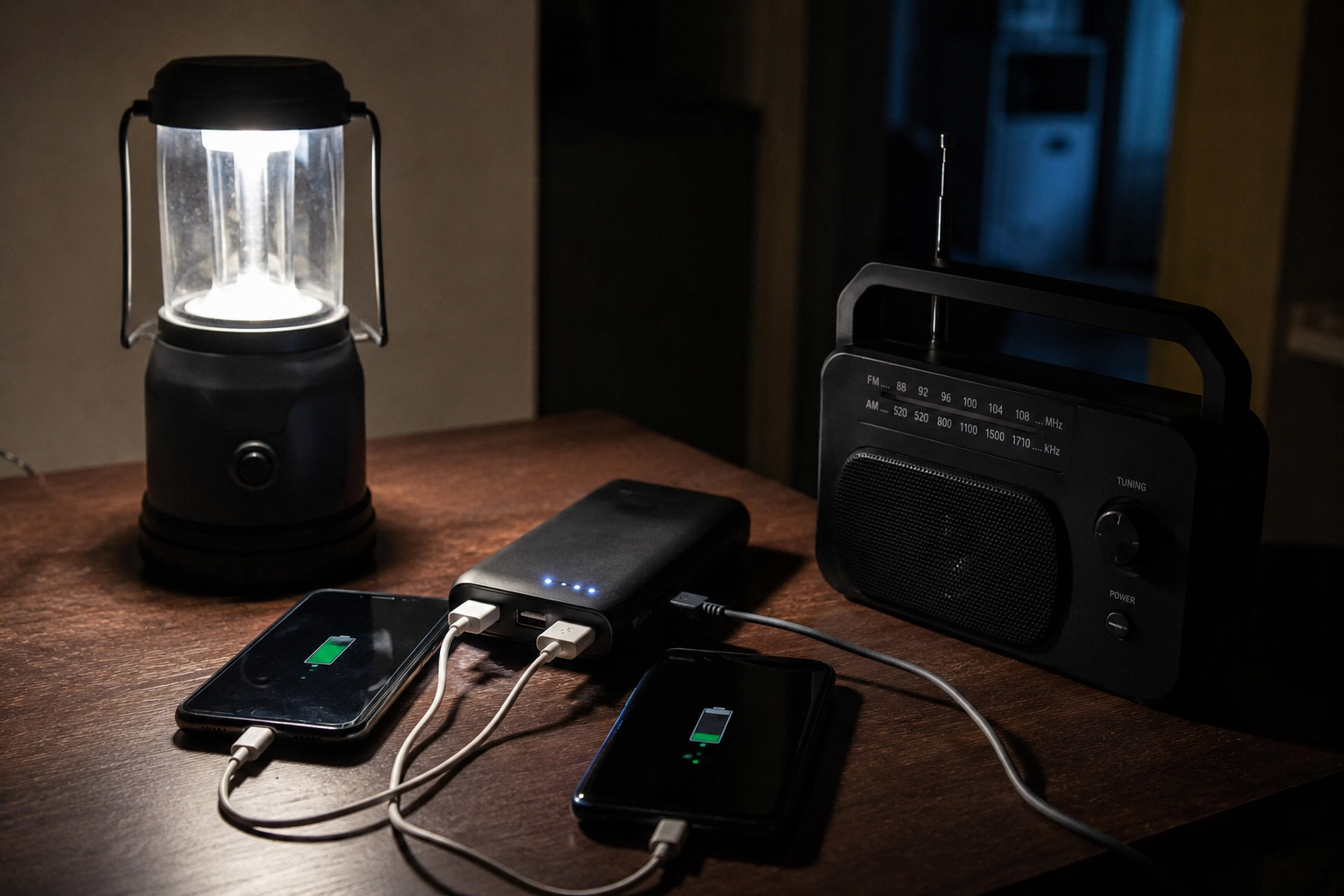
Layer 2 — LED Lantern: Area lighting for your primary living space. A high-lumen rechargeable LED lantern illuminates an entire room and charges via USB from your power station.
Layer 3 — Motion-Activated Stick Lights: Peel-and-stick LED lights placed in hallways, bathroom, and kitchen provide automatic illumination without requiring you to locate and activate a light source in the dark.
👉 Check Price on Amazon — Black Diamond Spot Rechargeable Headlamp
🌡️ Temperature — Managing Heat and Cold Without HVAC
Summer heat outages — Upper-floor apartments heat rapidly without air conditioning. A rechargeable personal misting fan, cooling towels, and strategic window management — open at night, closed and covered during peak daytime heat — provide meaningful relief. Battery-powered fans running from your power station extend comfort significantly. See our Heat Wave Survival Guide (2026) for complete heat management strategies.
Winter cold outages — Apartment insulation varies dramatically by building age and construction. Emergency Mylar blankets retain 90% of body heat and store in a jacket pocket. Layered clothing, sleeping bag rated below your expected indoor temperature, and keeping all household members in a single room to share body heat are the most effective cold management strategies available without supplemental heating.
📻 Communication — Stay Informed in Your Unit
Cell towers overload during major urban outage events. A NOAA hand crank weather radio provides official emergency alerts, shelter-in-place instructions, and weather updates independent of cell network status. Essential for high-rise residents who need to know whether staying in place or evacuating is the safer option.
👉 Check Price on Amazon — Kaito KA500 Hand Crank Emergency Weather Radio
Smart Storage Solutions for Small Spaces

Fitting emergency supplies into an apartment requires intentional organization rather than simply accumulating gear.
Under-bed storage — The most underutilized storage space in any apartment. Flat storage containers slide under a standard bed frame and hold a remarkable volume of non-perishable food, water containers, and emergency supplies completely out of sight.
Dedicated emergency backpack — A single well-organized backpack holds your most critical supplies — 72-hour food and water, first aid kit, power bank, flashlight, documents, and medications — in one grab-and-go package. Store it near your front door.
Closet shelf optimization — A single dedicated shelf for emergency supplies keeps your kit accessible and organized without consuming significant closet space.
Behind-door organizers — Over-door organizers hold small items — electrolyte packets, water purification tablets, emergency candles, first aid supplies — in otherwise unused space.
Your Apartment Outage Action Plan
When the power goes out:
- Connect critical devices to your power station immediately
- Fill your bathtub using your WaterBOB if you have advance warning
- Identify the safest temperature zone in your unit — lowest floor for summer, interior room for winter
- Text rather than call family — texts transmit on congested networks more reliably than voice calls
- Locate your headlamp and emergency radio before it gets dark
If the outage extends beyond 24 hours:
- Assess your building's temperature — if conditions become dangerous, identify your nearest public shelter or cooling/warming center
- Conserve power station charge by prioritizing critical devices — medical equipment, phone charging, essential lighting only
- Begin your no-cook food reserves to eliminate cooking fuel dependency
- Check on elderly or disabled neighbors who may need assistance
If evacuation becomes necessary:
- Grab your emergency backpack — it should be ready at all times
- Use stairwells — never elevators during an active outage
- Inform building management of your departure if possible
- Lock your unit and take your most critical documents
For a complete family evacuation and communication plan, see our Why Every Family Needs an Emergency Plan guide.
Final Thoughts
Apartment living does not make emergency preparedness impossible — it makes it different. The same core priorities apply — power, water, food, light, communication, and temperature management — but the solutions are compact, indoor-safe, and designed to work within the real constraints of apartment life.
A portable power station, a WaterBOB, a butane stove used near an open window, a rechargeable headlamp, and a hand crank weather radio fit in a single closet shelf and cover every core outage scenario your apartment might face.
Build your apartment kit before the next outage finds you unprepared. The investment is smaller than you think and the peace of mind is immediate.
Explore our complete Emergency Kits & Bundles and Shop All Survival Gear to build your apartment preparedness system today.
⚠️ Power outage season is here — apartment dwellers need a plan too. Build your kit before the lights go out.