Your bug out bag is only as good as the pack it's in. Choose the wrong backpack and you'll be dealing with broken zippers, blown seams, or a back-breaking load when you need to move fast. Choose right and your pack becomes the backbone of your entire emergency system.
This guide covers the best tactical packs for bug out bags in 2026 — ranked by capacity, durability, organization, and value. Whether you're building your first 72-hour kit or upgrading an existing setup, there's a pack on this list for every budget and skill level.

What Makes a Good Bug Out Bag Backpack?
Before diving into recommendations, here's what separates a great bug out bag backpack from a mediocre one:
Capacity: 40–72L for a full 72-hour kit. Too small and you can't fit essentials. Too large and you'll overpack and slow yourself down.
MOLLE webbing: Modular Lightweight Load-carrying Equipment — the grid of webbing straps that lets you attach additional pouches, holsters, and accessories. Essential for customizing your kit.
Material: 900D Oxford or 1000D Cordura nylon. Anything lighter tears under field use. Anything heavier adds unnecessary weight.
Comfort system: Padded, adjustable shoulder straps, sternum strap, and hip belt for load transfer. You'll be wearing this bag for potentially hours — comfort matters.
Hydration compatibility: A built-in hydration bladder sleeve keeps water accessible without stopping.
Best Tactical Backpacks for Bug Out Bags in 2026
1. 72L Tactical Backpack (REEBOW GEAR / G4Free) — Best Overall

Best for: Serious preppers who need maximum capacity
The 72L tactical backpack is the gold standard for full-scale bug out bag builds. Its high-capacity main compartment handles a complete 72-hour loadout — food, water, shelter, medical, tools, and clothing — with room to spare.
Key features:
- 72L main compartment
- Full MOLLE webbing exterior
- 900D Oxford fabric construction
- Padded laptop sleeve
- Sternum strap and padded hip belt
- Hydration bladder sleeve
2. 50L Tactical MOLLE Backpack — Best Balance of Size & Weight

Best for: Most preppers — the sweet spot between capacity and packability
The 50L tactical MOLLE backpack is the most versatile choice for the majority of preppers. Large enough to carry a complete 72-hour emergency kit, compact enough to move quickly when speed matters.
Key features:
- 50L optimized capacity
- Full MOLLE webbing system
- Ripstop nylon construction
- Hydration bladder sleeve (fits a 2-3L bladder)
- Ergonomic ventilated back panel
- Multiple organizational compartments
3. Jueachy Tactical Backpack — Best Budget Pick

Best for: Budget-conscious preppers and beginners
The Jueachy is one of Amazon's consistently best-selling tactical packs. It delivers genuine military-inspired durability at an accessible price point that makes it the top recommendation for preppers just starting to build their kit.
Key features:
- 900D polyester with reinforced seams
- 8 organized compartments
- Dedicated laptop sleeve and admin panel
- Hydration port
- Full MOLLE webbing front and sides
- Breathable back panel
4. Waterproof Dry Bag Backpack — Best for Wet Environments

Best for: Coastal areas, flood-prone regions, wet-weather evacuations
When your evacuation route crosses flooded terrain, rivers, or sustained downpour, a standard tactical pack fails. The waterproof dry bag uses welded seam construction and a roll-top closure to create a fully submersible seal.
Key features:
- Welded seam waterproof construction
- Roll-top submersible closure
- Durable PVC or TPU material
- Puncture and abrasion resistant
- Lightweight and packable
5. Tactical Sling Bag / EDC Crossbody Bag — Best Everyday Carry
Best for: Get-home bags, vehicle emergency kits, urban preppers
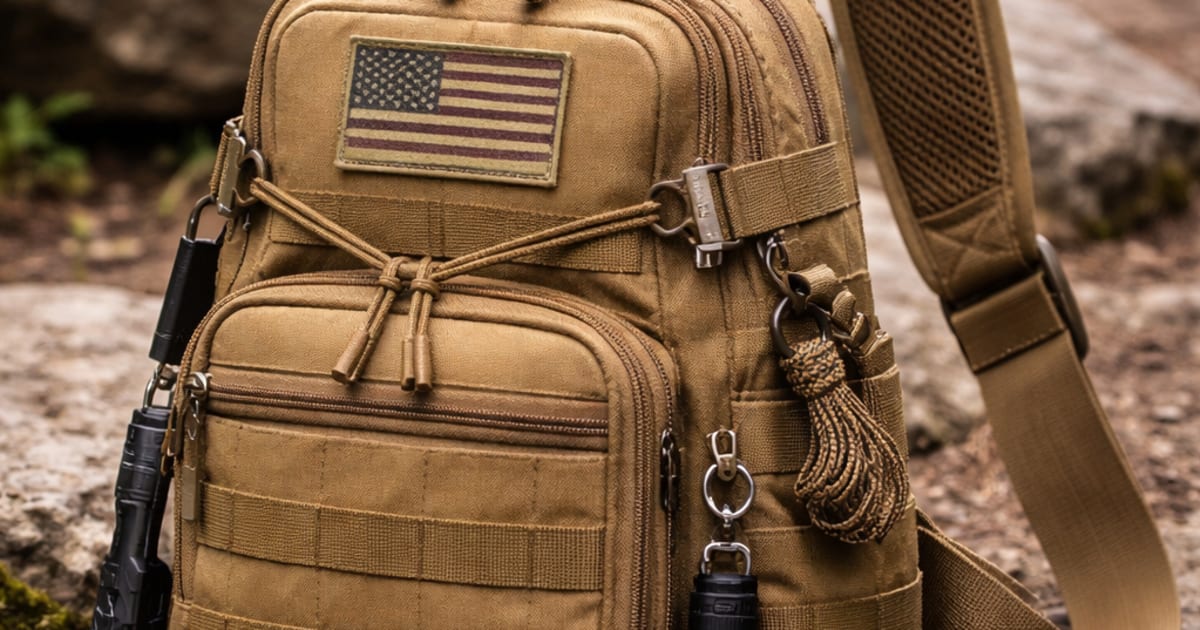
Not every emergency requires a full 72L pack. The tactical sling bag is your everyday carry solution — worn crossbody, it keeps critical gear within arm's reach at all times.
Key features:
- Single-strap crossbody design
- Rapid front-swing access
- Multiple zippered compartments
- MOLLE webbing exterior
- Water-resistant fabric
6. Mesh Drawstring Gear Organizer Bags — Best Organization Upgrade

Best for: Organizing the inside of any bug out bag
These lightweight mesh drawstring bags let you group gear by category — red for medical, green for food, black for tools — so you never dig for anything when seconds count.
Key features:
- Breathable mesh construction
- See-through for instant identification
- Multiple sizes in one pack
- Drawstring closure
- Lightweight
Bug Out Bag Backpack Comparison
| Pack | Capacity | Best For | Tier | |---|---|---|---| | 72L Tactical Backpack | 72L | Maximum loadout | Value | | 50L MOLLE Backpack | 50L | Most preppers | Value | | Jueachy Tactical | 40L | Budget/beginners | Budget | | Waterproof Dry Bag | 30L | Wet environments | Value | | Tactical Sling Bag | 15L | EDC/get-home | Budget | | Mesh Organizers | N/A | Organization | Budget |
How to Choose the Right Bug Out Bag Backpack
Step 1 — Determine your kit size. A basic 72-hour kit for one person fits in 40–50L. A comprehensive kit with extra clothing and gear needs 60–72L.
Step 2 — Consider your terrain. Urban evacuations favor lighter, less conspicuous packs. Rural and wilderness evacuations favor maximum capacity with frame support.
Step 3 — Factor in your fitness. Never carry more than 25% of your body weight. A 160lb person should carry no more than 40lbs.
Step 4 — Plan for family distribution. If evacuating with family, distribute weight across multiple packs. Each family member should carry their own water and shelter minimum.
Final Thoughts
The best tactical tactical pack for your bug out bag is the one you have packed and ready before you need it. Start with the 50L MOLLE Backpack if you're unsure — it's the most versatile option for most preppers at any experience level.
Build your complete bug out bag using our Bug Out Bag Essentials Checklist and explore our full Bug Out Bags category.
Also read: Best Water Filtration Systems for Survival in 2026
Related Reading:
I Put My ZIP Code Into the Grid Down Simulator — Here's What It Told Me About My Risk
I Tested My Home in a Grid-Down Scenario — Here's What Happened
What Happens If the Power Grid Goes Down? A Step-by-Step Survival Timeline