Wildfire Preparedness Guide 2026 — How to Protect Your Home and Family Before Fire Season
Fire season doesn't send a warning. One dry week, one downed power line, one spark in dry brush — and suddenly a neighborhood that felt completely safe is under mandatory evacuation with 15 minutes to leave. In 2026, that scenario is playing out earlier in the year, in more states, and in communities that never believed they were at risk.
The families who make it through wildfire events with the least loss aren't the ones who got lucky. They're the ones who spent a few hours preparing weeks before the smoke ever appeared on the horizon. This guide breaks down exactly what that preparation looks like — step by step — so your household is never caught off guard.

The 2026 Wildfire Reality — Why This Year Is Different
The scale of wildfire destruction has changed dramatically over the past decade. According to FEMA, wildfires now burn an average of 7 million acres annually across the United States — a number that has more than doubled since the 1990s. Extended droughts, record-breaking heat events, and persistent low humidity have created conditions where fires ignite faster, spread further, and resist containment longer than historical norms.
What makes 2026 particularly concerning is the expansion of the wildfire threat zone. States like Texas, Florida, and parts of the Midwest — regions not traditionally associated with wildfire risk — have seen significant fire activity in recent years. The assumption that wildfires happen somewhere else is no longer safe to rely on.
Beyond the fire itself, smoke has become a national public health crisis. During major wildfire events, hazardous air quality affects cities hundreds of miles from the nearest flame. The fine particles in wildfire smoke — PM2.5 — are small enough to pass through standard masks and penetrate deep into lung tissue. Extended exposure causes cardiovascular strain, respiratory inflammation, and long-term lung damage even in otherwise healthy adults.
April is National Wildfire Awareness Month, which means right now is exactly the right time to build your plan before summer heat arrives.
👉 Monitor active wildfires across the US in real time on our Live Disaster Tracker
Step 1 — Protect Your Lungs from Wildfire Smoke
Smoke is the first threat that reaches you — often days before a fire gets anywhere near your neighborhood. During regional wildfire events, air quality can drop to hazardous levels with almost no warning, and the effects accumulate quickly with each hour of exposure.
A standard surgical mask or cloth face covering provides no meaningful protection against wildfire smoke. The particles are simply too small. The only effective protection is a properly fitted N95 or KN95 respirator certified by NIOSH to filter at least 95% of airborne particles including PM2.5.
What to look for when choosing a wildfire smoke mask:
- NIOSH N95 or KN95 certification — not just N95-style or equivalent
- Dual strap design that creates a tight seal around the nose and jaw
- Adjustable nose wire that can be shaped to your face
- Individually sealed packaging so masks stay clean during storage
- Enough supply for your entire household for multiple days of use
Children present a particular challenge because most adult N95 masks don't seal properly on smaller faces. Look for child-sized respirator options or speak with your pediatrician about appropriate alternatives for young children during smoke events.
Store your masks somewhere immediately accessible — not buried in a storage closet. A shelf near the front door or in the car is ideal so they're available whether you're sheltering in place or evacuating.
👉 Stock up on NIOSH-rated N95 respirator masks before fire season starts
Step 2 — Control the Air Inside Your Home
During nearby wildfire events or regional smoke episodes, staying indoors is the recommended course of action — but only if your indoor air is actually cleaner than the air outside. Without proper filtration, smoke seeps through gaps around windows, doors, and HVAC systems, and indoor PM2.5 levels can actually exceed outdoor levels within a few hours.
A true HEPA air purifier running continuously in your main living space dramatically reduces the concentration of smoke particles indoors. HEPA filters are rated to capture 99.97% of particles 0.3 microns or larger, which covers the vast majority of wildfire smoke particles. Make sure the unit is appropriately sized for the room — check the CADR rating and match it to your square footage.
Additional steps to reduce indoor smoke infiltration:
- Switch your HVAC system to recirculate mode — this stops it from pulling smoky outdoor air inside
- Seal gaps around exterior doors and windows temporarily with towels or painter's tape
- Avoid activities that generate indoor air pollution during smoke events — cooking on the stove, burning candles, vacuuming
- Keep windows and doors closed even if it feels warm inside
- Run bathroom and kitchen exhaust fans as little as possible — they pull outdoor air in
If you have a forced-air HVAC system, replace the filter with a MERV-13 rated filter before fire season. These filters capture significantly more fine particles than standard HVAC filters and make a measurable difference during smoke events.
👉 A true HEPA air purifier keeps your home breathable during wildfire smoke events

Step 3 — Build Your Wildfire Go Bag
When an evacuation order comes, the clock starts immediately. Mandatory evacuations during active wildfire events are not suggestions — they are orders issued when the threat is already serious. The average window between an evacuation order and unsafe conditions in some wildfire scenarios is under 30 minutes.
The only way to leave quickly without leaving behind everything that matters is to have your go bag already packed and positioned near your exit before the emergency starts.
A wildfire go bag is a pre-packed 72-hour emergency kit organized specifically for evacuation. It needs to be comprehensive enough to sustain your family for three full days without access to stores, utilities, or services — and light enough that you can actually carry it while moving fast.
Complete wildfire go bag contents:
Documents and identification:
- Copies of passports, driver's licenses, birth certificates
- Insurance policies and contact numbers
- Deed or lease documents
- Stored on a USB drive AND printed in a waterproof bag
Survival essentials:
- Water — minimum 1 liter per person for the bag (additional water in your car)
- High-calorie non-perishable food — energy bars, trail mix, freeze-dried pouches
- Manual can opener if bringing canned food
- N95 masks — one per person per day minimum
- Goggles to protect eyes from ash and debris
- Work gloves
Medical and personal:
- Full first aid kit
- All prescription medications — minimum 7-day supply with prescriptions included
- Extra glasses or contacts with solution
- Infant supplies if applicable
- Personal hygiene basics — toothbrush, soap, sanitary supplies
Communication and power:
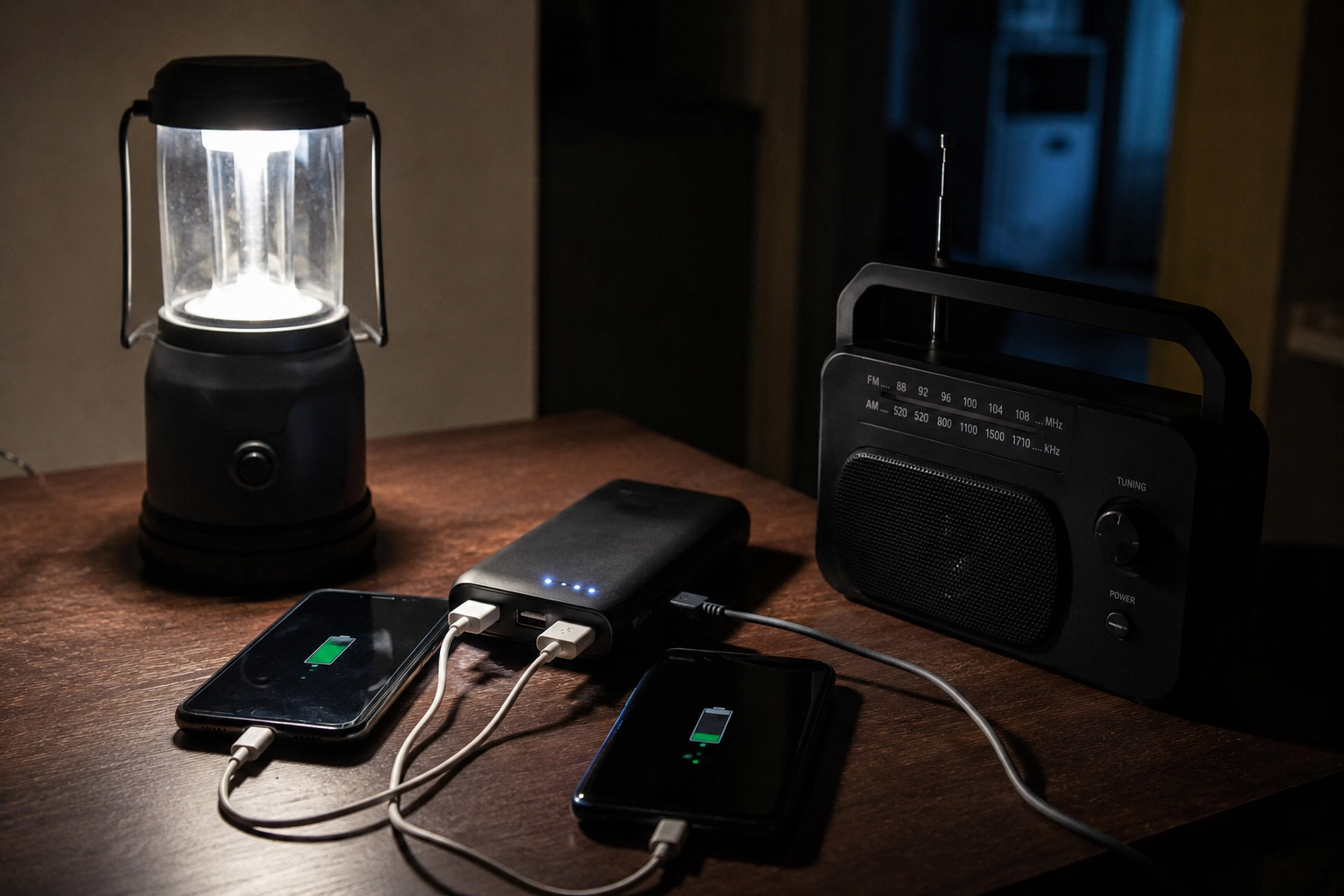
- Fully charged portable battery bank
- Phone charging cables for every device
- Hand-crank or battery NOAA weather radio
- Whistle for signaling
Practical items:
- Cash in small bills — ATMs may be offline
- Change of clothes for each family member
- Sturdy closed-toe shoes for everyone
- Emergency mylar blanket
- Duct tape and multi-tool
Review and refresh your go bag every six months. Replace expired food and medications, update document copies, and verify that electronics and batteries still hold a charge.
👉A pre-packed 72-hour go bag means your family can evacuate in minutes — not hours
👉 Get the complete bug out bag packing checklist with every item you need

Step 4 — Build Your Family Wildfire Evacuation Plan
A packed bag without a clear plan is only half the equation. Every member of your household needs to know exactly where to go, how to get there, and how to reconnect if family members are separated when the evacuation order comes — including children at school and adults at work.
Your evacuation plan must cover:
Two exit routes from your home and neighborhood. Wildfires spread unpredictably and can block roads without warning. Identify a primary route and a completely separate backup route in a different direction. Drive both routes before fire season so everyone knows them.
A family meeting point outside your neighborhood. Choose a specific, recognizable location — a school, fire station, or landmark — that is unlikely to be threatened by fire. Every family member must know this location by memory, not just by phone lookup.
An out-of-area emergency contact. During regional disasters, local phone lines become congested and calls fail. Designate one person who lives outside your region that every family member can text or call to report their location and status. Text messages often get through when calls cannot.
A communication plan for separated family members. Decide in advance: if school is evacuated separately, where will children be taken? If a parent cannot reach home, where do they go? Make these decisions now so no one has to make them under pressure.
A pet and livestock plan. Know which emergency shelters in your area accept pets. Have carriers, leashes, food, water bowls, and vaccination records packed and ready. For livestock owners, identify where animals will be transported and have a trailer plan in place.
👉 Build a complete family emergency plan step by step with our guide
Step 5 — Harden Your Home Before You Leave
If time and conditions allow before an evacuation — or if you live in a high-risk zone and want to reduce long-term fire risk — basic home hardening steps significantly improve your home's chances of surviving nearby wildfire activity.
Embers are responsible for the majority of home ignitions during wildfires. They travel up to a mile ahead of the fire front, landing on roofs, in gutters, against wood siding, and in piles of dry vegetation. A home that survives isn't necessarily one that was never reached by fire — it's often one where embers had nowhere to catch.
Home hardening actions that make a real difference:
- Clean gutters and remove accumulated leaves, pine needles, and debris from your roof
- Clear dry vegetation, dead leaves, and flammable materials within 30 feet of your home
- Move firewood, propane tanks, and patio furniture with cushions away from the structure
- Screen or seal openings in eaves, vents, and under decks where embers can enter
- Close all windows, doors, garage doors, and pet doors before evacuating — this slows fire entry significantly
- Connect garden hoses to exterior spigots so they are ready for use by firefighters
These actions take less than two hours for most homes and can make the difference between a home that survives and one that doesn't.
Step 6 — Stay Connected with Real-Time Emergency Alerts
Wildfire conditions change fast. An area under a fire watch at noon can be under mandatory evacuation by early afternoon. Staying connected to official alerts is not optional during wildfire season — it is the mechanism that gives you time to act.
Set up multiple alert channels:
County emergency alert system — Every county has an emergency notification system. Sign up at your county's official website to receive evacuation orders and warnings directly to your phone via call, text, and email. This is the most critical alert source during a wildfire event.
Wireless Emergency Alerts (WEA) — These are the alerts that appear on your phone screen automatically during declared emergencies. Make sure your phone is set to receive them — check your notification settings.
NOAA Weather Radio — During a wildfire event, power outages and cell tower damage can make phones unreliable. A battery-powered or hand-crank NOAA weather radio receives official emergency broadcasts continuously without requiring cell service or internet.
Local news and social media — Follow your county sheriff, local fire department, and emergency management office on social media for real-time updates during active events.

'
Wildfire Preparedness Checklist — Print and Complete This
Smoke Protection:
- [ ] N95 or KN95 masks purchased for every household member
- [ ] Child-sized masks sourced if applicable
- [ ] True HEPA air purifier installed and running
- [ ] HVAC filter upgraded to MERV-13
- [ ] HVAC set to recirculate mode during smoke events
Go Bag:
- [ ] 72-hour go bag packed and positioned near exit
- [ ] Documents copied and stored in waterproof bag
- [ ] Medications packed with minimum 7-day supply
- [ ] Portable battery bank fully charged
- [ ] Cash in small bills included
Evacuation Plan:
- [ ] Two exit routes from home and neighborhood identified
- [ ] Family meeting point agreed upon and memorized
- [ ] Out-of-area emergency contact designated
- [ ] School and workplace pickup/communication plans established
- [ ] Pet carriers, food, and records ready
Home Hardening:
- [ ] Gutters cleared of debris
- [ ] 30-foot defensible space cleared around home
- [ ] Flammable items moved away from structure
- [ ] Exterior hoses connected and accessible
Stay Informed:
- [ ] Signed up for county emergency alert system
- [ ] NOAA weather radio accessible and working
- [ ] Local emergency agencies followed on social media
The Time to Prepare Is Before the Smoke Appears
Wildfire preparedness isn't driven by fear — it's driven by the understanding that the choices made before an emergency determine the outcome during one. The smoke masks sitting in a drawer before fire season are the ones that protect your family when air quality drops overnight. The go bag by the door is the reason you leave in 10 minutes instead of 45.
Every step in this guide is something you can complete before fire season peaks. Start with the two highest-impact actions: getting your N95 masks and packing your go bag. Build the rest of your plan from there. The window to prepare before conditions peak is closing — and the families who act now are the ones who won't have to scramble later.
👉 Browse all essential emergency preparedness gear on Essential Items
👉 Use our interactive emergency preparedness checklist to track what you have and what you still need