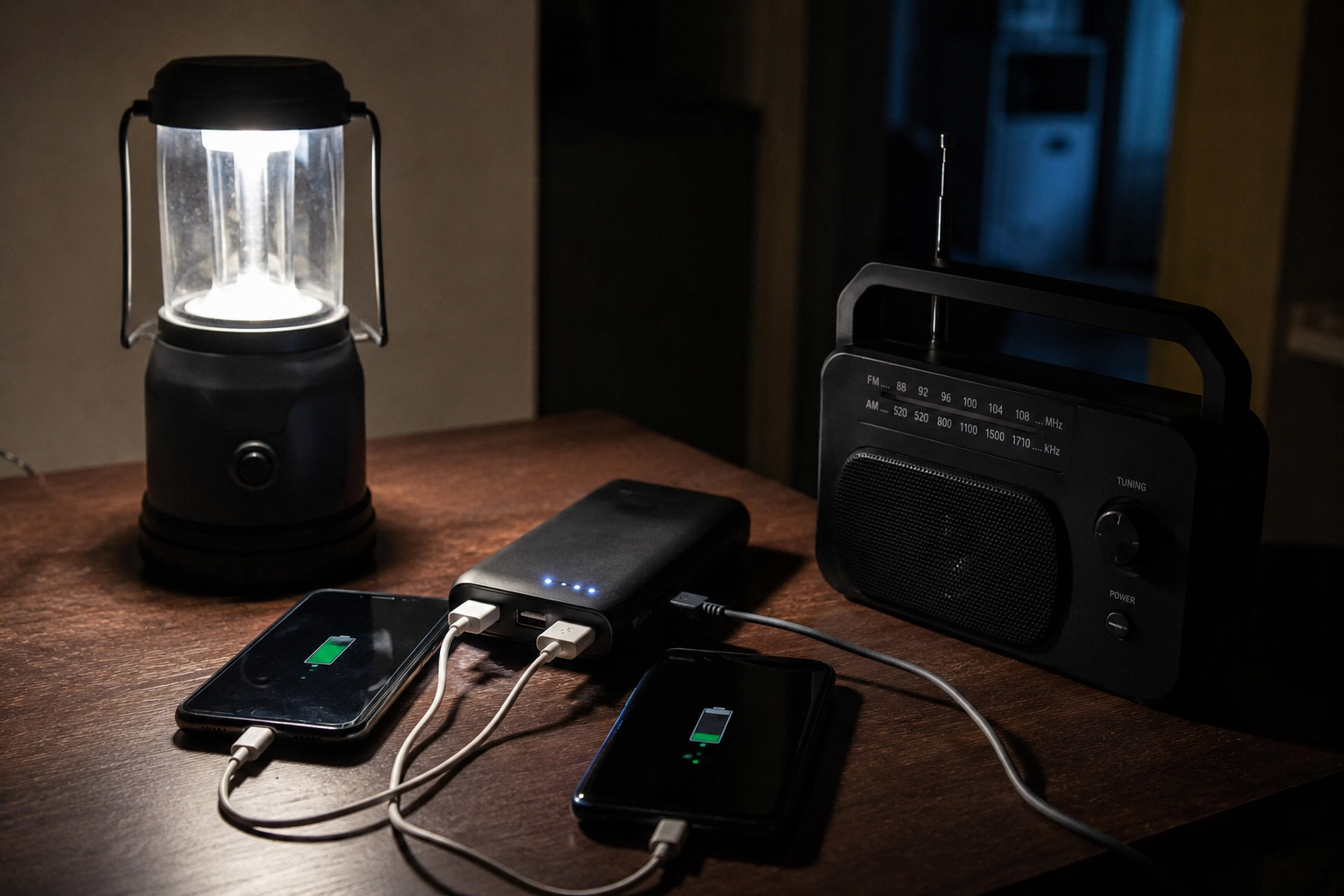
When the power goes out, most people reach for their phone. It is the first instinct — call a family member, check the news, find out what is happening. For the first few hours of most outages, that instinct works. But during an extended power outage, the network your phone depends on begins failing in ways most people have never considered.
Cell towers are not immune to power failures. They depend on the same electrical grid that powers your home — and when that grid goes down, towers switch to backup systems that have a very limited lifespan. In a major blackout, cell service can degrade significantly within 8 hours and fail entirely within 24 to 48 hours in the hardest hit areas.
Communication failure compounds every other emergency. Without the ability to reach family members, receive official emergency broadcasts, or coordinate with neighbors, a manageable situation becomes significantly more dangerous. The households that come through communication blackouts intact are the ones that understood this vulnerability before it happened — and built backup communication plans that do not depend on cell service.
This guide explains exactly what happens to cell towers during a power outage, how long service typically lasts, why it gets worse before it gets better, and what your household needs to stay connected when the network goes silent.
How Cell Towers Get Power

Understanding why cell service fails during a blackout starts with understanding how cell towers get their power under normal conditions — and what happens when that power source disappears.
Under normal grid conditions, cell towers draw power directly from the electrical grid through utility connections. This is the same power that runs your home, your office, and every other building in your neighborhood. When that grid power disappears, towers do not simply shut off — they switch to backup systems designed to bridge the gap until grid power is restored.
The first layer of backup is a battery bank installed at the base of most towers. These batteries are designed to keep the tower operational for a limited period — typically four to eight hours depending on the tower's power consumption and the size of the battery bank installed. During this window, your cell service may feel completely normal. You would have no way of knowing the tower is running on borrowed time.
The second layer of backup is a diesel or propane generator, installed at towers where carriers have invested in extended backup capability. When the battery bank is depleted, the generator kicks in — but generators require fuel, and fuel requires delivery. In a widespread power grid failure, fuel delivery trucks face the same road conditions, fuel shortages, and logistical challenges as everyone else. Many generators run out of fuel within 24 to 72 hours of a major outage simply because resupply cannot reach them in time.
Rural towers and towers in areas with older telecom infrastructure are more likely to have limited or no generator backup. Urban towers in high-density markets tend to have more robust backup systems — but they also serve exponentially more users, which creates a different problem entirely.
For a complete understanding of how power grid failure cascades through every critical system your household depends on, the complete grid down survival guide covers every layer. The post on what happens if the power grid goes down walks through the full hour by hour timeline of infrastructure collapse.
How Long Do Cell Towers Work During a Blackout?

The honest answer is that it depends — on your location, your carrier, the scale of the outage, and how quickly fuel can reach backup generators. But broad patterns emerge consistently across major outage events that give us a realistic picture of what to expect.
In a localized outage affecting a small area, cell service often remains functional throughout the event. Towers on the edge of the outage zone continue to draw grid power normally and can serve users in the affected area. Generator-equipped towers within the zone keep running as long as fuel holds out. For most short-duration outages of 12 hours or less, most users in most areas retain functional cell service.
In a widespread regional outage affecting hundreds of thousands or millions of people simultaneously, the picture changes dramatically. Battery backups begin depleting within the first four to eight hours. Generators that were properly fueled begin running by hour eight and run out of diesel by hours 24 to 72 depending on tank capacity and load. By the 48 hour mark of a major outage, a significant percentage of towers in the most heavily affected areas will be offline.
Even towers that remain powered face a separate problem — network congestion. During the first hours of any major emergency event, call and data volume spikes dramatically as everyone tries to reach family, check news, and coordinate plans simultaneously. This congestion can make cell service effectively unusable even when the towers themselves are still running.
The post on what happens after day 3 of a power outage covers exactly how conditions deteriorate as a blackout extends beyond the initial 72 hours — including how communication infrastructure continues to degrade. For context on how outage duration varies by region and event type, the guide on how long do power outages last by state gives you real data on what extended outages look like in your area.
Why Cell Service Gets Worse During Emergencies
Even when towers are still running and powered, cell service during a major emergency is often functionally worse than during normal conditions. This is not a coincidence — it is the predictable result of how cellular networks are designed and how human behavior changes during crisis events.
Cellular networks are engineered to handle average traffic loads efficiently. Each tower serves a defined geographic area and a defined capacity of simultaneous connections. Under normal conditions, that capacity is more than sufficient — most people are not making calls or using heavy data simultaneously at any given moment.
During an emergency, that assumption breaks down completely. Every person in the affected area reaches for their phone at the same moment. Call attempts spike by hundreds or thousands of percent above normal volume within the first minutes of an emergency declaration. The network responds by dropping calls, blocking connections, and routing traffic in ways that prioritize emergency services — leaving civilian calls unable to connect at all.
Text messages often get through when calls cannot — they use significantly less network bandwidth and can be queued and sent in gaps between congestion bursts. This is why emergency management agencies consistently advise texting over calling during major events. But even text delivery can be delayed by hours during peak congestion.
Internet-dependent communication — social media, messaging apps, video calls — requires both cell connectivity and functioning internet infrastructure. When either fails, these platforms become inaccessible regardless of how much battery life your phone has remaining.
Understanding the full range of infrastructure threats that can take cell service offline helps you build a more complete communication plan. The post on EMP attack vs cyber attack breaks down the two most discussed threats to communication infrastructure and how each one affects your ability to stay connected.
Best Backup Communication Options During a Grid Down Event

Building a backup communication plan means having tools that work completely independently of cell towers, internet infrastructure, and grid power. Here is what every household needs layered across multiple backup options.
A hand crank NOAA weather radio is the most important single communication device for any power outage scenario. It gives your household one-way access to official emergency broadcasts, evacuation orders, and real time situation updates completely independent of cell service, internet, or grid power. Look for a unit with solar charging capability and a USB output so it can also serve as a backup phone charger. The complete guide on best hand crank emergency radios covers the top rated options by reliability and features.
Check Price on Amazon – Hand Crank NOAA Emergency Radio with Solar Charging and USB Output
Two-way radios — GMRS or FRS walkie talkies — give your household the ability to communicate locally without any network infrastructure at all. They work tower-to-tower between units, covering ranges of two to twenty-five miles depending on the model and terrain. This makes them essential for keeping family members in contact during evacuations, coordinating between different locations, and communicating with neighbors during extended outages.
Check Price on Amazon – Emergency Walkie Talkies Rechargeable Long Range for Blackout Communication
Keeping your devices charged is the third layer of backup communication capability. A high-capacity power bank gives you multiple full phone charges without grid power — critical for the hours when cell service is still functional and every charge counts. A solar phone charger extends that capability indefinitely as long as there is daylight — making it one of the most practical long-term communication support tools available.
Check Price on Amazon – High Capacity Power Bank for Emergency Phone Charging During Blackout
Check Price on Amazon – Portable Solar Phone Charger for Off-Grid Emergency Communication
For households that want the most robust communication capability available outside of professional emergency services, a satellite communicator provides two-way messaging and SOS capability that works anywhere on Earth regardless of cell infrastructure status. The complete guide on best off-grid communication devices covers the full range of backup communication options from walkie talkies to satellite messengers. For households building a complete bug out kit around communication capability, the bug out bag essentials guide covers where communication gear fits within a complete 72-hour emergency kit.
How to Prepare for a Communication Blackout
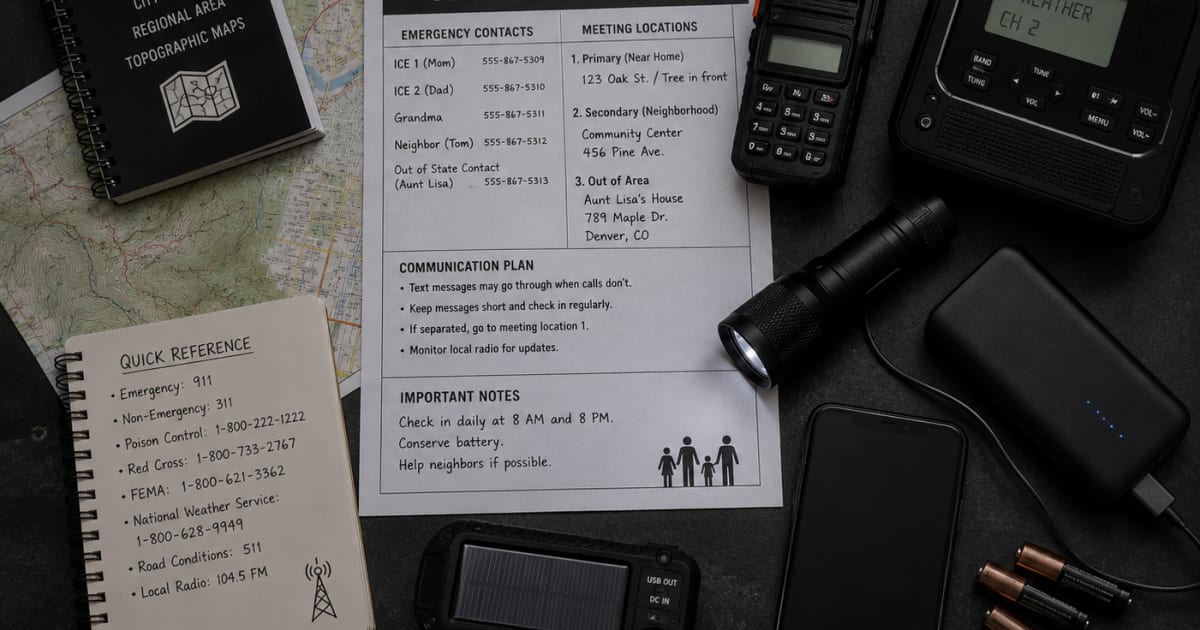
Having the right devices is only half of a complete communication plan. The other half is the human infrastructure — the contacts, meeting points, plans, and agreements that let your household function when digital communication fails entirely.
A written family communication plan is one of the most overlooked and highest-impact emergency preparedness steps available. When phones are dead and apps are inaccessible, a laminated card in every household member's wallet with emergency contacts, a designated out-of-state family contact, and two or three pre-agreed meeting locations gives your family a functional coordination system that requires zero technology to execute.
Out-of-state contacts matter more than most households realize. During a regional emergency, local phone lines get congested and blocked. Out-of-state calls often connect more reliably because they route through different network infrastructure that is not under the same congestion load. Designating a single out-of-state family member as the communication hub — where everyone checks in and reports their status — can keep a scattered family coordinated even when direct calls between members are impossible.
Offline maps downloaded to your phone before an emergency give you navigation capability when internet access is unavailable. Most mapping apps including Google Maps and Apple Maps allow offline map downloads for specific regions. Download your local area, your evacuation routes, and any destination you might need to reach during an emergency while you still have internet access.
Keep all communication devices fully charged whenever severe weather or emergencies are forecast. A phone at 100 percent when the power goes out gives you significantly more usable communication time than one at 40 percent — and in a long outage, every hour of battery life matters.
The guide on why every family needs an emergency plan covers the complete framework for building a family plan that every household member can execute under pressure. For a room by room approach to getting your entire home ready for extended outages, the guide on how to prepare your home for a power outage in 7 days gives you a practical week long action plan that includes communication preparation.
Check Price on Amazon – Compact Solar Charger Panel for Emergency Phone and Device Charging
Emergency Communication Checklist
Use this checklist to assess your household communication readiness right now. Every item checked is one less vulnerability when the cell network goes dark.
Devices:
- Hand crank NOAA weather radio with solar charging
- Two-way walkie talkies — one set per household
- High capacity power bank fully charged
- Solar phone charger for indefinite off-grid charging
- Spare batteries for all battery-powered devices
Plans and Documentation:
- Written family communication plan — laminated card for every member
- Designated out-of-state family contact agreed upon in advance
- Two to three pre-agreed meeting locations within your area
- Printed emergency contact list in waterproof pouch
- Offline maps downloaded for your area and evacuation routes
Charging and Power:
- All devices fully charged before any forecast emergency
- USB charging cables for every device stored with your kit
- Backup battery bank stored in your emergency kit at all times
Advanced Communication:
- GMRS radio license if using long-range two-way radios
- Satellite communicator for remote area or worst-case scenarios
- Ham radio Technician license for maximum communication range
Prepare for Silence Before It Happens
Cell service feels permanent until it is not. Most households never experience a true communication blackout — and that lack of experience creates a false sense of security about what is actually available when the grid fails and the towers go dark.
Communication failure creates panic faster than almost any other emergency consequence. When you cannot reach your family, cannot get news, and cannot coordinate even basic plans, fear fills the information vacuum. The households that stay calm and functional during communication outages are the ones that built their backup systems before the emergency — not the ones scrambling to find a radio or remember a phone number when the network is already gone.
Start with a hand crank radio and a power bank this week. Write down your emergency contacts and meeting points this weekend. Download offline maps to every phone in your household before the next storm season. These are small, practical steps that take almost no time — and they make an enormous difference when the silence comes.
For a complete preparedness framework covering blackout survival, emergency food, backup power, water storage, and long-term grid failure preparation, read our full Complete Grid Down Survival Guide (2026).
The network will fail again somewhere. Make sure your household is ready to communicate without it.