When a major power outage hits, most households think about food, water, and flashlights. Very few think about fuel — until they get in their car and realize every gas station within twenty miles has a dark sign and a locked door.
Fuel is one of the most overlooked elements of emergency preparedness. It powers your vehicle for evacuation, runs your generator, and keeps your household functional when everything else has stopped. And like water, groceries, and cell service, fuel access depends on a chain of infrastructure that can fail faster than most people ever anticipate.
Gas stations depend entirely on electricity to operate. The pumps that move fuel from underground tanks to your vehicle require electric motors. The payment systems require internet connectivity and power. The backup generators that some stations have installed can only run as long as their fuel supply lasts — and during a major regional outage, that supply runs out quickly.
This guide explains exactly why gas stations fail during power outages, how long fuel access typically lasts during different types of emergencies, and the specific steps your household can take to make sure you are never stranded without fuel when a crisis begins.
Why Gas Stations Depend on Electricity

The modern gas station is far more dependent on electrical infrastructure than it appears from the outside. What looks like a simple pump and a convenience store is actually a complex system of electrically powered components — any one of which can bring the entire operation to a halt when grid power disappears.
The fuel pumps themselves are the most obvious dependency. Underground storage tanks hold thousands of gallons of fuel, but that fuel cannot reach your vehicle without electric submersible pumps installed in the tanks. These pumps require continuous grid power to operate. When electricity goes out, the pumps stop — and all the fuel in those underground tanks becomes completely inaccessible without a generator to power the pump system.
Payment processing is the second critical dependency. Modern point-of-sale systems require both power and internet connectivity to process credit and debit card transactions. Without both, card payments are impossible. While some stations can accept cash manually, many modern stations are not staffed or equipped to handle significant cash volume — particularly overnight or in rural locations with minimal staff.
Fuel delivery systems face the same power dependencies at the supply chain level. Fuel terminals and distribution centers require electricity to operate their loading equipment. Tanker trucks require fuel of their own to make deliveries. During a widespread infrastructure failure, the entire chain from refinery to pump can be disrupted simultaneously — meaning even stations with backup generators eventually run out of fuel with no resupply arriving to replace what was pumped.
For a complete picture of how power grid failure cascades through every critical system your household depends on, the complete grid down survival guide covers every layer of preparation. The post on what happens if the power grid goes down walks through the full hour by hour timeline of infrastructure collapse.
How Long Can Gas Stations Operate During a Power Outage?

The honest answer depends on three variables — whether the station has a backup generator, how much fuel that generator has, and whether resupply can reach the station before both run out. The pattern across major outage events gives us a consistent and sobering picture.
Stations without backup generators go dark immediately when grid power fails. This is the majority of gas stations in most regions — particularly smaller independent operators and stations in rural areas where the economics of generator installation are harder to justify. For these stations, the moment the grid goes down is the moment fuel access ends.
Stations with backup generators stay operational as long as their generator fuel holds out. Most backup generators at gas stations are sized to run the essential pump and payment systems — not the entire facility. A properly fueled generator might keep a station running for 24 to 72 hours depending on consumption rate and tank capacity. After that, without a resupply delivery, the generator stops and the station closes.
The fuel resupply problem compounds everything. During a regional power outage, fuel terminals face the same power disruptions as the stations they supply. Tanker drivers face congested roads, closed highways, and fuel shortages of their own. Priority deliveries go to emergency services — hospitals, fire stations, and police departments — before commercial resupply resumes. Most commercial stations in a major outage zone can expect resupply delays measured in days, not hours.
The guide on how long do power outages last by state gives you real data on outage durations in your region — critical context for understanding how long you may need to sustain yourself without fuel access. The post on what happens after day 3 of a power outage covers exactly how conditions deteriorate as a blackout extends beyond the initial 72 hours.
Why Fuel Shortages Happen So Fast During Emergencies
The speed at which fuel disappears during emergencies consistently catches people off guard — even people who consider themselves reasonably prepared. Understanding the mechanics of fuel shortages helps you act ahead of the curve rather than behind it.
Panic buying is the primary accelerant. The moment a hurricane warning, major storm forecast, or emergency declaration is issued, drivers begin filling their tanks regardless of how much fuel they currently have. A driver with three-quarters of a tank fills it to full. A driver with half a tank fills it to full. Multiply this behavior by thousands of drivers simultaneously and the demand spike overwhelms even well-stocked stations within hours.
Fuel hoarding compounds the panic buying problem. Drivers who make it to an open station during the early hours of an emergency often fill not just their vehicle tank but also every approved container they own. During major hurricane evacuations, it is common to see vehicles at gas stations with five-gallon containers, ten-gallon containers, and assorted jugs being filled alongside vehicle tanks — dramatically accelerating the depletion rate of available fuel.
Evacuation traffic creates a separate demand surge that is entirely geographic. When a mandatory or voluntary evacuation order is issued, hundreds of thousands of vehicles begin moving along the same evacuation corridors simultaneously. Gas stations along those corridors face demand volumes they were never designed to handle — and many run dry within the first hours of the evacuation order.
The pattern mirrors what happens with food supplies during emergencies. The post on how fast grocery stores empty during emergencies covers the same cascade effect in the food supply chain. And for households planning for the worst-case infrastructure threats, the post on EMP attack vs cyber attack explains how different threat types affect fuel infrastructure differently.
How to Prepare for Fuel Shortages Before a Blackout
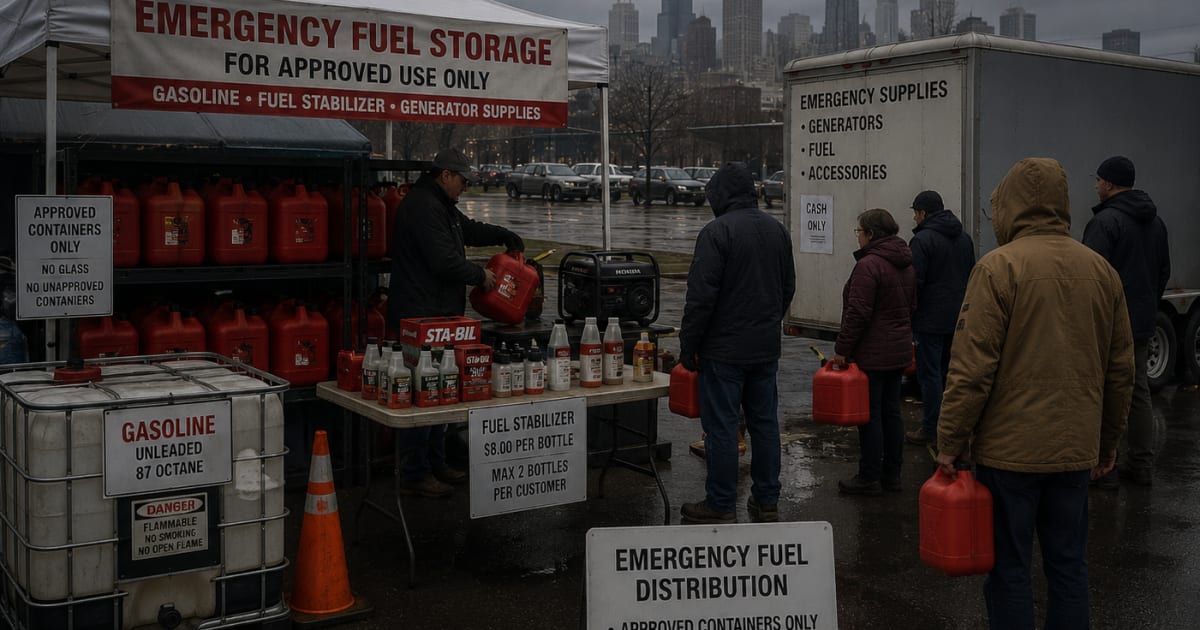
The most effective fuel preparedness strategy requires almost no special equipment and costs almost nothing to implement — it just requires a habit change and a small amount of planning before any emergency is on the horizon.
The single most impactful fuel preparedness step available to any household is maintaining your vehicle tank above the half-full mark at all times. This simple habit — treating a half-full tank as your minimum rather than your refill trigger — gives you a meaningful fuel reserve at any given moment without storing a single container of gasoline. During the first hours of an emergency when stations are still open but lines are forming, a half-full tank buys you time to decide whether to fill up or move to other priorities.
For households with generators or those who want a stored fuel reserve, approved gasoline containers are the correct storage solution. Look for containers certified to ASTM F3326 or equivalent standards with a proper spout and venting system.
Check Price on Amazon – Approved Gasoline Storage Container for Emergency Fuel Preparedness
Stored gasoline degrades over time — typically becoming unusable within three to six months without treatment. A quality fuel stabilizer extends stored gasoline shelf life to twelve months or longer, making it practical to maintain a meaningful fuel reserve without constant rotation.
Check Price on Amazon – Fuel Stabilizer for Long-Term Emergency Gasoline Storage
A siphon pump gives you the ability to transfer fuel between containers, vehicles, and generators without spilling — a practical tool that costs almost nothing and proves its value the moment you need to move fuel in an emergency.
Check Price on Amazon – Siphon Pump for Emergency Fuel Transfer and Storage
For households with generators, maintain a minimum two-week fuel supply alongside your generator at all times. The guide on best portable generators for power outages covers the top generator options at every budget and the fuel consumption rates you need to calculate your storage requirements. For a complete room by room approach to emergency preparedness including fuel planning, the guide on how to prepare your home for a power outage in 7 days gives you a practical week long action plan. The bug out bag essentials guide covers where vehicle and fuel planning fits within a complete 72-hour emergency kit.
Best Backup Transportation and Fuel Strategies
Fuel preparedness is not just about having gasoline stored — it is about having a transportation plan that does not collapse the moment fuel becomes scarce.
Electric vehicles face a unique challenge during grid down events. Without grid power to charge them, EVs become immobile once their battery is depleted. Households with EVs should maintain a full charge whenever severe weather or emergencies are forecast and have a clear plan for what happens if charging becomes impossible for an extended period.
Hybrid vehicles offer a significant advantage in fuel shortage scenarios. Their improved fuel efficiency means a full tank goes considerably farther than a standard gasoline vehicle — buying more time before a fill-up is necessary and reducing the number of trips to congested gas stations.
Bicycles are the most underrated emergency transportation option available to most households. For distances under ten miles in an urban or suburban environment, a bicycle is faster than a car stuck in evacuation traffic, requires zero fuel, and is completely immune to grid failure. Keeping a basic bike repair kit on hand — tire patches, a pump, and basic tools — maintains that capability regardless of infrastructure status.
Check Price on Amazon – Emergency Bike Repair Kit for Backup Transportation Preparedness
A portable jump starter kept in every vehicle eliminates the risk of a dead battery compounding a fuel shortage — ensuring that whatever fuel you have stored or managed to access actually gets you where you need to go. The guide on why every family needs an emergency plan covers evacuation route planning and transportation coordination as part of a complete family emergency framework. For households considering solar backup power as part of their energy independence strategy, the guide on best solar generators and power stations covers the options that can reduce your generator fuel dependency significantly.
Emergency Fuel Preparedness Checklist
Use this checklist to assess your household fuel readiness right now. Every item checked is one less vulnerability when the pumps go dark.
Vehicle and Fuel:
- Vehicle tank maintained above half full at all times
- Approved gasoline containers stored safely for emergency reserve
- Fuel stabilizer added to all stored gasoline
- Stored fuel rotated every six to twelve months
Generator Fuel:
- Minimum two-week generator fuel supply stored safely
- Generator tested and running before any emergency is declared
- Spare oil and maintenance supplies stored with generator
Vehicle Emergency Kit:
- Portable jump starter in every vehicle
- Basic tool kit and tire repair supplies
- Physical maps of local area and evacuation routes
- Emergency cash for cash-only fuel transactions
Transportation Backup:
- Bicycle maintained and ready for short-distance emergency travel
- Basic bike repair kit stored and accessible
- Evacuation routes planned and known by all household members
- Out-of-area fuel availability researched along evacuation corridors
Fuel Access Disappears Faster Than Most People Expect
Fuel infrastructure is more fragile than it looks. The gas station on the corner of your street depends on the same electrical grid as your home — and when that grid fails, the pumps stop within minutes. The backup generator buys hours, not days. The resupply tanker that would restock the underground tanks may not arrive for days after a major regional outage.
By the time most households realize fuel is a problem, the lines are already forming and the stations that are still open are hours from running dry. Panic buying and evacuation traffic accelerate the depletion rate beyond anything a normal demand pattern would produce.
The households that maintain their vehicles above half full, keep a small stored fuel reserve, and have a transportation backup plan are the ones that navigate fuel shortages without panic. These are not complex or expensive preparations — they are simple habits that cost almost nothing and make an enormous difference when the infrastructure your household depends on stops working.
For a complete preparedness framework covering blackout survival, emergency food, water storage, communication systems, and long-term grid failure preparation, read our full Complete Grid Down Survival Guide (2026).
Fill your tank before you need to. Prepare before the pumps go dark.