When the power goes out, most people think about flashlights, phone batteries, and whether the food in the refrigerator is going to spoil. Very few people think about water — and that is exactly the problem.
Water systems depend on electricity far more than most households realize. Municipal water treatment plants, pumping stations, and pressure systems all run on grid power. When that power disappears, the water infrastructure your household depends on can begin failing within hours — and in an extended blackout, it can stop working entirely.
Losing water is often more immediately dangerous than losing electricity. You can light candles, use a battery-powered radio, and eat shelf-stable food in the dark. You cannot survive more than three days without clean drinking water, and you cannot maintain basic sanitation without a functional water supply.
This guide explains exactly what happens to water systems during a power outage, what the risks are in the first 24 to 72 hours, and the specific steps your household can take right now to make sure you never face a water crisis on top of a blackout.
How Municipal Water Systems Depend on Electricity

Most people have no idea how much electricity their tap water requires. From the moment water is pulled from a source to the moment it comes out of your faucet, it passes through multiple electrically powered systems — any one of which can fail during a power grid failure.
Water treatment plants use electricity to power the pumps, filtration systems, ultraviolet disinfection units, and chemical dosing equipment that make raw water safe to drink. These facilities run continuously, and most of them are not equipped with backup generators capable of sustaining full operations for more than a day or two. When grid power goes down and generator fuel runs out, treatment capacity drops — and the water entering the distribution system may no longer meet safety standards.
Pumping stations are the second critical vulnerability. Municipal water systems maintain pressure through a network of electric pumps that push treated water through distribution pipes to homes and businesses across an entire service area. Without those pumps running, pressure drops. In low-lying areas served by gravity-fed reservoirs, you may retain water pressure for a period of time. In areas that depend entirely on electric pumping, pressure can disappear within hours of an outage.
Wastewater systems face the same problem in reverse. Sewage treatment plants and lift stations — the pumping facilities that move sewage through underground pipes — also run on electricity. When lift stations lose power, sewage backs up in the system. Extended power outages have caused raw sewage overflows that contaminate local water sources and create serious public health hazards.
Some larger utilities have backup generators for critical systems, but these are designed to bridge short-term outages — not sustain full water operations through a major infrastructure collapse. For a complete picture of how grid failure cascades through every system your household depends on, the complete grid down survival guide covers every layer. The post on what happens if the power grid goes down walks through the full timeline hour by hour.
What Happens During the First 24 to 72 Hours of a Power Outage?
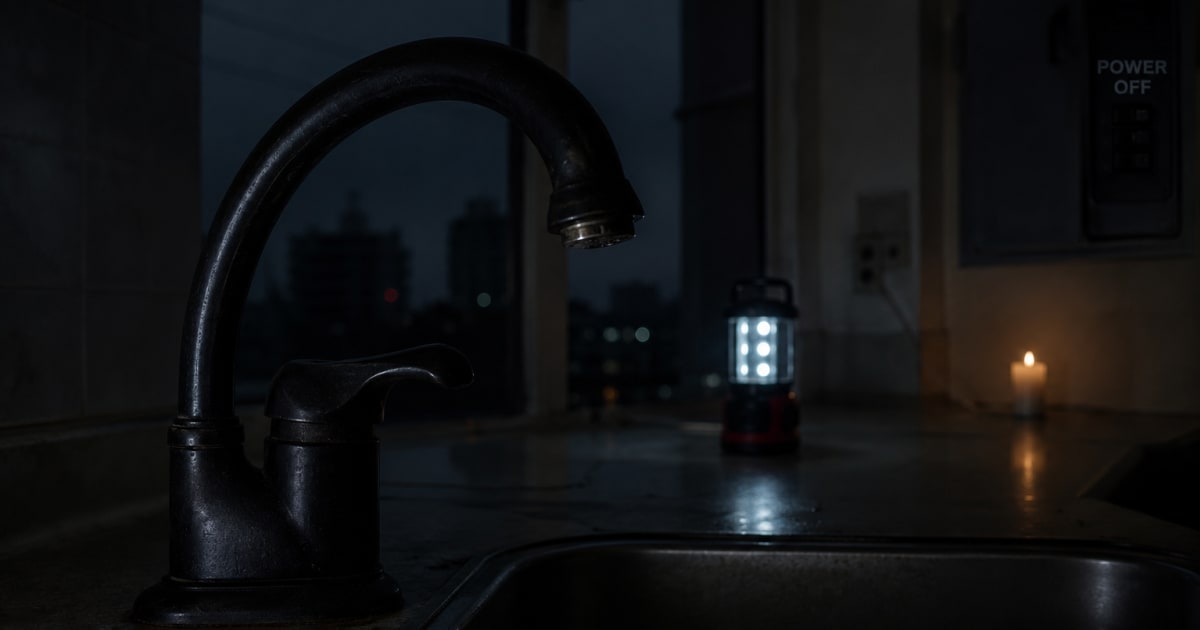
The first 24 hours of a power outage are often deceptive. Your taps may still run normally because pressure built up before the outage is still moving through the system. But as that stored pressure dissipates and pumping stations lose power, the situation changes quickly.
Between 12 and 24 hours into a significant outage, low-pressure warnings often begin in areas furthest from reservoirs or pumping sources. Taps begin to slow. Upper floors in multi-story buildings and homes at higher elevations are typically the first to lose pressure entirely as gravity works against the remaining system pressure.
By the 24 to 48 hour mark in a major blackout, boil water advisories become common. When pressure drops low enough, the risk of contaminant intrusion into distribution pipes increases significantly — outside material can be drawn into the system through pipe joints and cracks. Health authorities issue boil water advisories as a precaution, but boiling water requires a heat source that many households do not have during a power outage.
Grocery store water supplies disappear within hours of a major emergency being declared. The combination of boil water advisories and public awareness of the situation triggers immediate panic buying that empties store shelves faster than most people anticipate. If you do not have water stored before the outage begins, you may not be able to get it after.
Sanitation becomes a cascading concern as the outage extends. Without running water, handwashing, cooking, and toilet flushing all become difficult or impossible. The guide on what happens after day 3 of a power outage covers exactly how conditions deteriorate as a blackout extends past the initial 72 hours. For a room by room preparation plan you can complete before any emergency, the guide on how to prepare your home for a power outage in 7 days gives you a practical week long action plan.
Can You Still Flush Toilets During a Blackout?
This is one of the most common questions households face during an extended power outage — and the answer depends entirely on your plumbing setup.
If your home is connected to a municipal sewer system, your toilets will continue to flush as long as water pressure is available. The toilet tank refills using incoming water pressure — when that pressure disappears, the tank stops refilling and you lose flushing capability after the water already in the tank is used. Most toilet tanks hold enough water for one to two flushes after pressure is lost.
If your home uses a private septic system with an electric pump, that pump loses power during an outage. Some septic systems are gravity-fed and continue to function without electricity. Others rely entirely on electric pumps to move waste — and those stop working when the grid goes down.
For households on municipal water, filling your bathtub immediately when an outage begins gives you a significant reserve of water for flushing. A standard bathtub holds 40 to 80 gallons — enough for dozens of flushes over several days. This is one of the most practical and overlooked emergency water strategies available to any household.
When flushing becomes impossible, a portable camping toilet with waste disposal bags is the most sanitary solution. Combined with hand sanitizer and wet wipes, it keeps basic sanitation functional regardless of water availability. These are not luxury items in an extended grid down event — they are essential equipment.
How to Prepare Your Household Water Supply
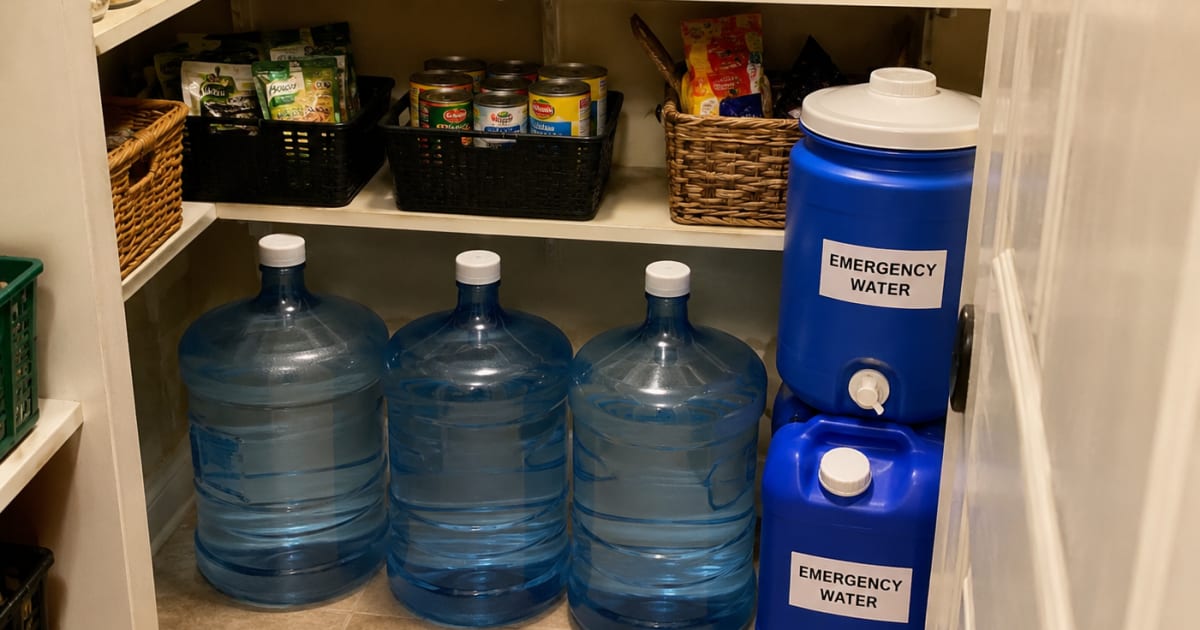
The window between when a major emergency is announced and when store shelves are empty is measured in hours — not days. Your household water supply needs to exist before the emergency, not after.
The standard recommendation from FEMA and the Red Cross is one gallon of water per person per day. For a family of four over 72 hours that is 12 gallons minimum. For a genuine long-term blackout preparation that covers two weeks, that same family needs 56 gallons stored and accessible.
Store water in BPA-free containers specifically rated for long-term water storage. Avoid repurposing milk jugs or thin plastic bottles — they degrade over time and can harbor bacteria that make stored water unsafe. Stackable five-gallon containers give you organized, space-efficient storage that is easy to rotate and access. Large capacity tanks in the 30 to 55 gallon range are ideal for households with space to store them.
Beyond containers, your water storage plan needs a rotation schedule. Stored water should be replaced every six to twelve months to ensure it stays safe. Keep your containers in a cool, dark location away from direct sunlight and chemical products that could off-gas into the plastic.
Do not forget water for pets, cooking, and sanitation — these uses add significantly to your daily requirement beyond just drinking. A realistic household water budget for a power outage emergency is closer to two gallons per person per day when all uses are accounted for.
The guide on best emergency water storage solutions covers the top containers and storage systems at every budget, and the guide on best water filtration systems for survival covers backup filtration options for when your stored supply runs low.
Check Price on Amazon - Emergency Water Filtration System for Power Outage and Grid Down Survival
Best Backup Water Solutions During a Grid Down Event
Stored water covers your immediate needs — but a complete household water plan includes backup solutions that extend your supply if the outage runs longer than expected.
A gravity-fed water filter is one of the most practical backup solutions available. It requires no electricity, no pressure, and no moving parts — just pour water in the top and collect filtered water from the bottom. Quality gravity filters remove bacteria, protozoa, and most chemical contaminants from virtually any water source — bathtubs, collected rainwater, streams, and emergency distribution points. This gives your household a virtually unlimited water supply as long as any water source is available.
Check Price on Amazon - Gravity-Fed Water Filter for Emergency and Grid Down Survival
Water purification tablets are the lightest and most affordable backup option in any emergency kit. A single tablet treats one liter of water in 30 minutes and eliminates the biological contaminants most likely to be present in compromised water supplies. Keep a supply in your home emergency kit, your bug out bag, and your car kit — they weigh almost nothing and cost almost nothing, making them one of the highest value items in any preparedness setup.
Check Price on Amazon - Emergency Water Purification Tablets for Blackout and Survival Preparedness
Rainwater collection is another valuable off-grid water option during extended outages. A food-grade collection barrel connected to a downspout can collect significant volumes of water during rain events — water that can then be filtered and purified for drinking or used directly for sanitation and flushing.
Understanding the full range of infrastructure threats that can disrupt your water supply helps you build a more complete preparedness plan. The post on EMP attack vs cyber attack breaks down the two most discussed grid disruption threats and how preparation overlaps between them. And if you are building out your food supply alongside your water prep, the guide on best emergency food kits for survival covers the top ready-made options for long-term blackout food storage.
Final Emergency Water Checklist
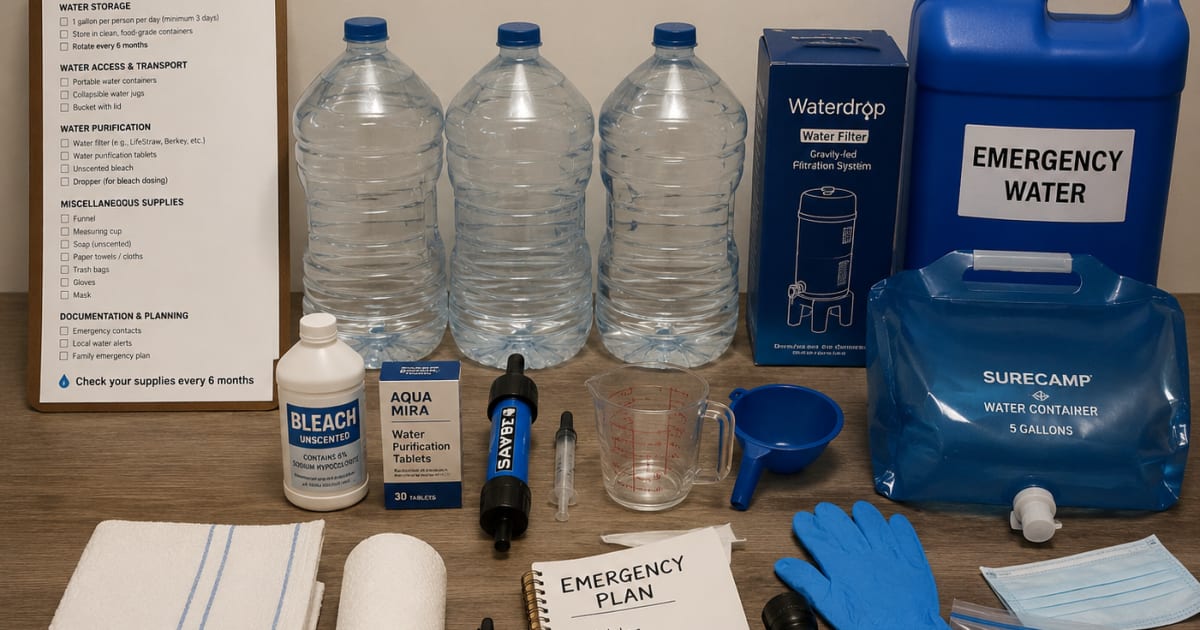
Use this checklist to assess your household water readiness right now. Every item checked is one less vulnerability when the water stops running.
Stored Water:
Minimum two-week supply at one to two gallons per person per day BPA-free storage containers rated for long-term use Water stored in cool dark location away from chemicals Rotation schedule set for every six to twelve months
Filtration and Purification:
Gravity-fed water filter for processing any water source Water purification tablets in home kit, bug out bag, and car kit Backup water filtration system rated for bacteria and chemical removal
Sanitation Supplies:
Portable camping toilet with waste disposal bags Hand sanitizer and antibacterial wet wipes Biodegradable soap for hygiene without running water
Emergency Containers:
Bathtub filled immediately at onset of outage Additional backup containers for cooking and sanitation water Food-grade collection barrel for rainwater if space allows
Store Water Before You Need It
Losing water during a power outage is often harder to manage than losing electricity itself. You can adapt to darkness. You cannot adapt to thirst, contaminated water, or a household that cannot maintain basic sanitation for days on end.
The households that come through extended blackouts with the least disruption are the ones that treated water storage as seriously as any other emergency preparation. Not because they expected the worst — but because they understood that a two-week supply of stored water and a gravity filter costs almost nothing compared to the cost of being without safe water for days.
Start with a two-week water supply this week. Add a gravity filter and purification tablets next. Fill your bathtub the moment any major weather event or emergency is announced. These are small, practical steps that take almost no time and cost very little — and they make an enormous difference when the taps stop running.
For a complete preparedness framework covering food storage, backup power, emergency communication, and long-term blackout survival, read our full Complete Grid Down Survival Guide (2026).
Water is not optional. Prepare for it now.