Two of the most discussed threats to modern infrastructure get confused constantly — and the confusion matters. An EMP attack and a cyber attack can both bring down the power grid, disrupt communication systems, and create long-term blackout scenarios that leave millions of people without power, water, or access to food. But they work in completely different ways, cause different types of damage, and have very different probabilities of actually happening.
Understanding the difference is not just an academic exercise. It shapes how you prepare, what gear you prioritize, and how realistic your emergency plan actually is.
This guide breaks down exactly what an EMP attack is, what a cyber attack on the power grid looks like, how the two threats compare side by side, and — most importantly — what practical steps your family can take right now to be ready for either scenario.
What Is an EMP Attack?
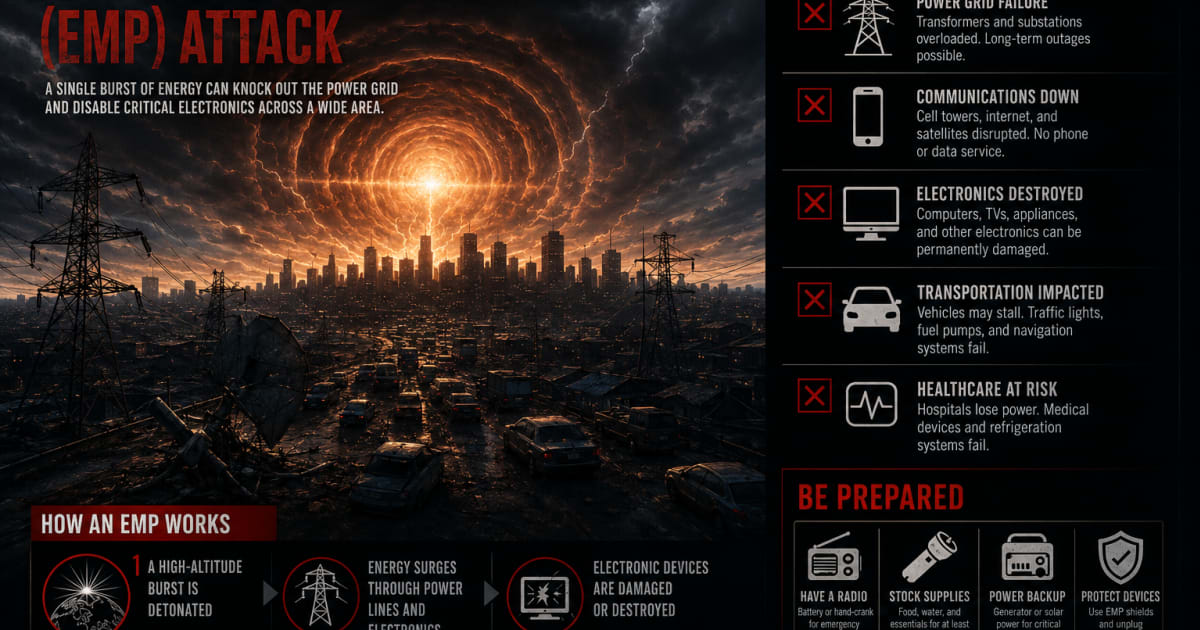
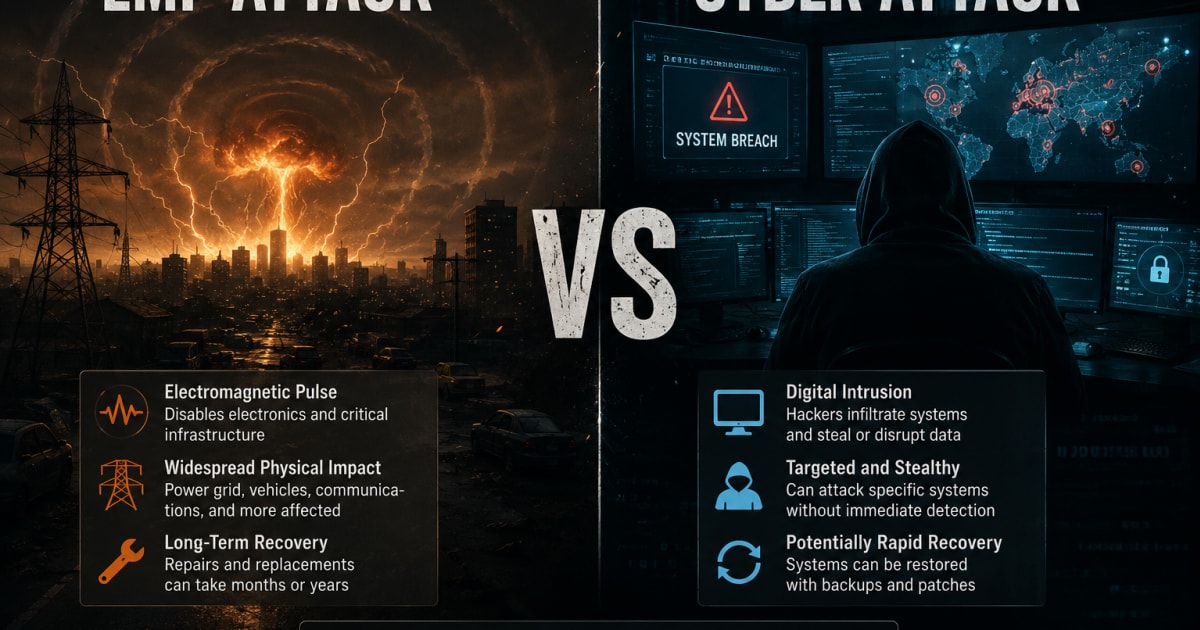
An electromagnetic pulse — or EMP — is a burst of electromagnetic energy that can disable or destroy electronic devices across a wide area. It is one of the most discussed and least understood threats in emergency preparedness circles.
There are two primary sources of an EMP event. The first is a nuclear EMP — a high-altitude nuclear detonation that releases a massive electromagnetic burst capable of covering an entire continent. The pulse travels at the speed of light and damages anything with a semiconductor — cars, phones, computers, transformers, and grid infrastructure simultaneously. Recovery from a nuclear EMP event would take years, not weeks, because the physical components of the power grid itself would need to be replaced at scale.
The second source is a solar flare or coronal mass ejection — a naturally occurring event where the sun releases a massive wave of charged particles that interacts with Earth's magnetic field. A severe solar storm, like the Carrington Event of 1859, could produce EMP-level damage to modern electrical infrastructure without any human involvement at all.
The core danger of an EMP attack is physical destruction. Unlike a cyber attack that disrupts software and control systems, an electromagnetic pulse attack burns out hardware — circuit boards, transformers, and electronic components that cannot simply be rebooted or patched. That is what makes EMP attack survival planning different from standard blackout preparedness.
For a complete picture of what a worst-case infrastructure failure looks like from day one through the weeks that follow, the complete grid down survival guide covers every layer of preparation. The post on what happens if the power grid goes down walks through the hour by hour survival timeline when large-scale grid failure occurs.
What Is a Cyber Attack on the Power Grid?
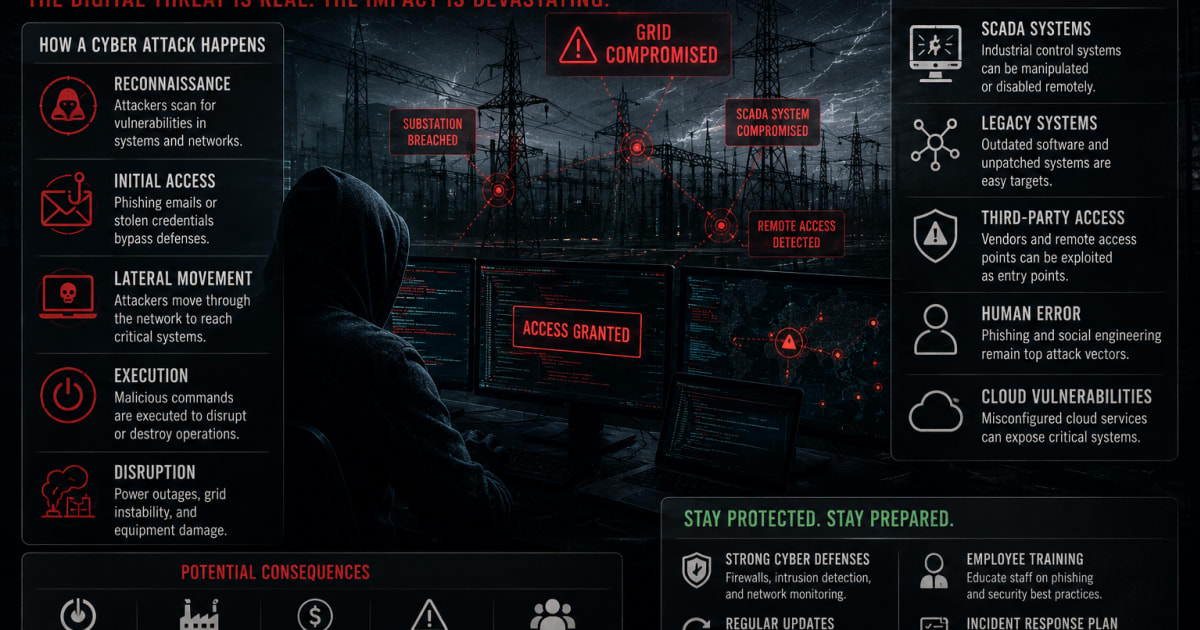
A cyber attack on the power grid is a digital intrusion — hackers targeting the software, control systems, and communication networks that utilities use to manage electricity generation and distribution. Unlike an EMP, a grid cyber attack does not physically destroy hardware. It exploits vulnerabilities in the digital systems that tell physical infrastructure what to do.
The most common forms of grid cyber attack include ransomware — malicious software that locks utility operators out of their own control systems until a ransom is paid — and direct sabotage of industrial control systems that manage power generation, transmission switching, and substation operations.
These are not theoretical threats. Utilities in the United States, Europe, and Ukraine have already been targeted by state-sponsored hacking groups with documented intent to disrupt power supply. In 2015 and 2016, cyber attacks on Ukrainian power utilities left hundreds of thousands of customers without electricity during winter months — demonstrating that a successful grid cyber attack is not just possible but has already happened.
The recovery timeline for a cyber attack varies significantly depending on the scale and sophistication of the intrusion. A localized ransomware attack might be resolved in days. A coordinated attack on multiple grid control systems simultaneously could produce a regional blackout lasting weeks.
A hand crank emergency radio is one of the most important tools for staying informed during any power outage regardless of the cause. The guide on best hand crank emergency radios covers the top rated options for grid down communication. For a deeper breakdown of this specific threat, the post on cyber attack on the power grid covers exactly what to expect and how to prepare your household before it happens.
EMP Attack vs Cyber Attack — Key Differences
Understanding how these two threats compare side by side clarifies both the risks and the preparation priorities. Here is a direct comparison:
| Threat | EMP Attack | Cyber Attack | |---|---|---| | Cause | Electromagnetic pulse | Digital hacking | | Damages Electronics | Yes — physically destroys hardware | Sometimes — software disruption | | Grid Failure | Severe and widespread | Localized to widespread | | Recovery Time | Years in worst case | Days to weeks | | Likelihood Today | Low but possible | High and ongoing |
The most important takeaway from this comparison is how much preparation overlaps between the two threats. Despite the dramatic differences in cause, scale, and recovery time, the core preparation for both an EMP attack and a cyber attack on the power grid is essentially identical — food storage, water supply, backup power, and off-grid communication cover the immediate survival needs for both scenarios.
The key difference is the recovery timeline. A successful cyber attack might mean a two-week blackout. An EMP event at scale means planning for a long-term blackout measured in months or years — which changes how much you store and how self-sufficient your household needs to be.
Which Threat Is More Likely?
Being honest about probability matters in emergency preparedness. Preparing for realistic scenarios first makes your household genuinely more resilient — not just theoretically ready for worst-case events.
Cyber attacks on power grid infrastructure are happening right now. Utilities in the United States and abroad are targeted regularly by state-sponsored hacking groups and criminal organizations. The question for most experts is not whether a significant grid cyber attack will occur but when and how severe it will be.
An EMP attack from a nuclear detonation remains a low-probability event — it requires a hostile nation state to detonate a nuclear weapon at high altitude over a populated region, a threshold that carries enormous geopolitical consequences. A solar EMP event is a natural phenomenon that scientists monitor continuously and is considered possible but not imminent.
For most households, a cyber-triggered power outage is the more practical threat to prepare for. The good news is that preparation for a moderate-duration cyber attack blackout builds the same foundation you need if a more severe event ever occurs.
The post on what happens after day 3 of a power outage breaks down exactly how conditions change as an outage extends — useful context for understanding what either of these scenarios actually looks like on the ground.
How to Prepare for Either Scenario
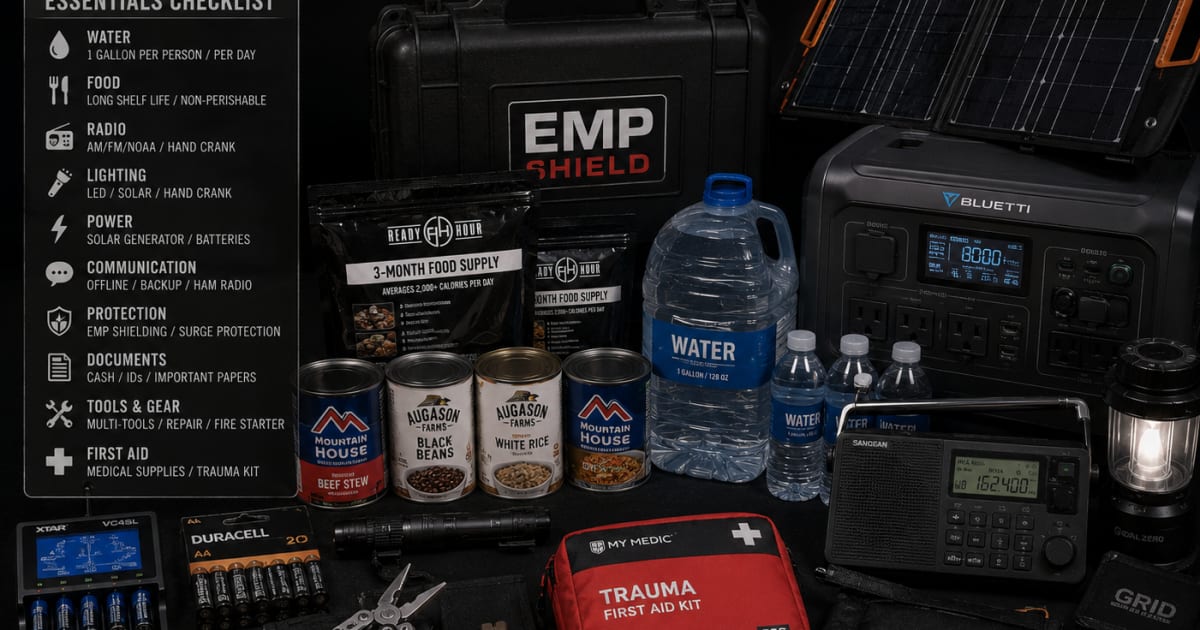
The practical preparation for both an EMP attack and a cyber attack on the power grid converges on the same core priorities. Here is what every household needs regardless of which scenario unfolds.
Food and water are your foundation. A minimum two-week supply of shelf-stable food and stored water covers the most likely duration of a cyber-triggered blackout and begins to address the longer-term needs of an EMP event. Freeze-dried meals and canned goods provide calorie-dense, long shelf life options that require minimal preparation. The best emergency food kits for survival covers the top ready-made options, and the best water filtration systems for survival gives you a backup water supply that does not depend on municipal infrastructure.
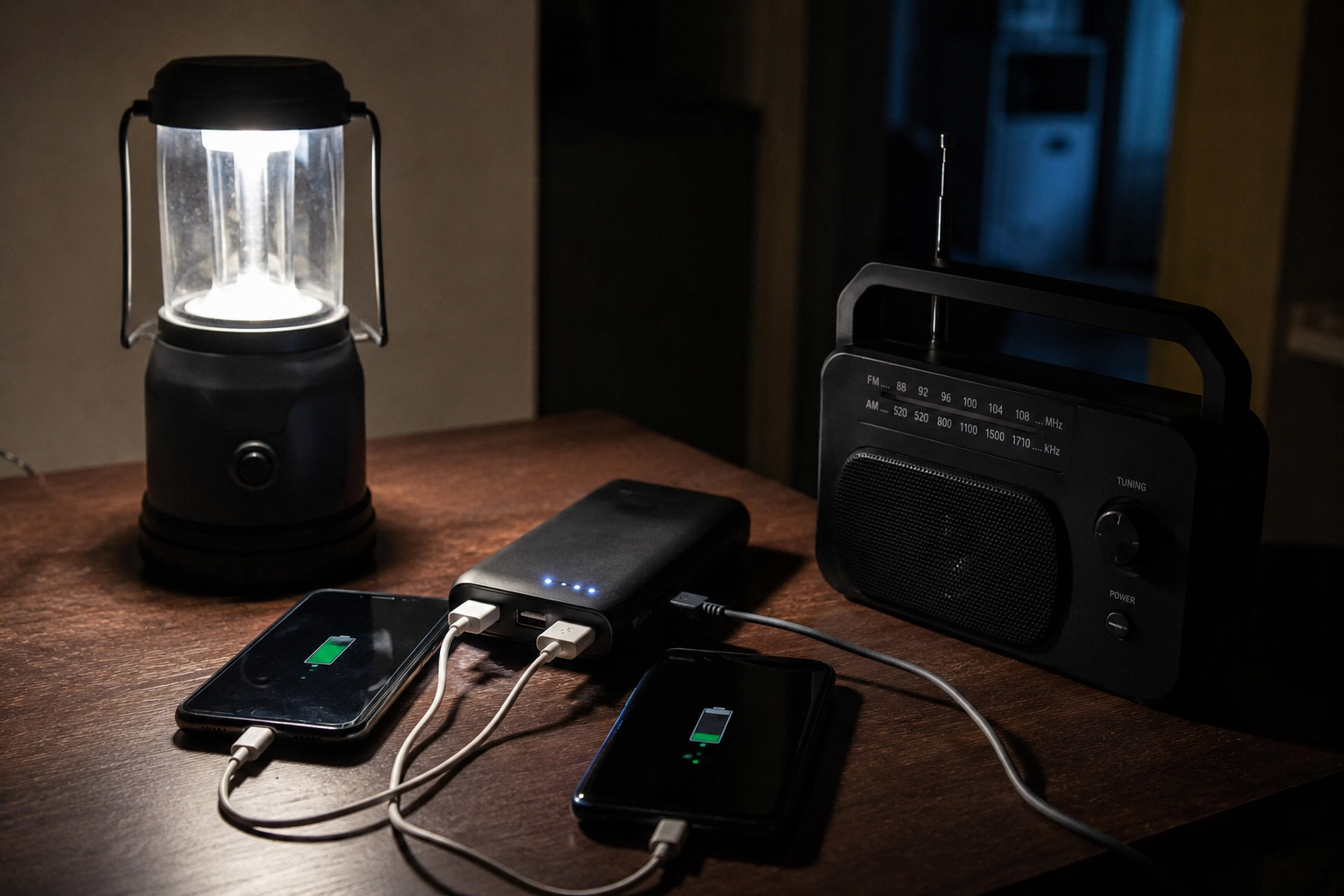
Backup power that does not rely on the grid is essential for both scenarios. A solar generator is the most practical long-term power solution — it recharges from the sun indefinitely and operates silently indoors. The guide on best solar generators and power stations covers the top options at every budget.
Check Price on Amazon – Hand Crank NOAA Emergency Radio for Grid Down Survival
Check Price on Amazon – Portable Solar Generator for EMP and Cyber Attack Blackout Survival
A bug out bag gives your household the ability to evacuate with 72 hours of supplies if sheltering in place becomes unsafe. The bug out bag essentials guide covers everything that belongs in a properly packed kit.
First aid capability matters more than most households plan for. When medical infrastructure is stressed after a major blackout, your household needs to handle injuries and medical needs independently for longer than usual. The best first aid kits for emergency preparedness covers the trauma-ready options worth having.
Check Price on Amazon – Freeze-Dried Emergency Food Kit for Long-Term Blackout Survival
Final Preparedness Checklist
Use this checklist to assess your household's readiness for either an EMP event or a cyber attack blackout right now:
Food and Water:
- Two-week supply of freeze-dried meals and canned goods
- One gallon of water per person per day for two weeks
- Quality water filtration system as backup
Power and Lighting:
- Portable solar generator or battery power station
- LED lantern for area lighting
- Tactical flashlight and headlamp per household member
- Extra batteries for all battery-powered devices
Communication:
- Hand crank NOAA weather radio with solar charging
- Two-way radios for local coordination
- Written emergency contact list in waterproof pouch
Safety and Medical:
- Trauma-rated first aid kit
- Seven-day supply of prescription medications
- N95 respirators and work gloves
Bug Out and Evacuation:
- Fully packed 72-hour bug out bag per household member
- Written family emergency plan and evacuation routes
Prepare for What You Can Control
Both an EMP attack and a cyber attack on the power grid can disrupt modern life faster than most people expect. The difference in cause does not change the immediate reality on the ground — no power, no running water, no communication, and no access to the supply chains your household depends on every day.
Preparedness is not about living in fear of either scenario. It is about making practical decisions ahead of time so that when disruption happens — whatever the cause — your family is not caught scrambling.
Start with the basics this week. Build your food and water supply. Get a hand crank radio and a backup power source. Put together a first aid kit and a bug out bag. Every small step your household takes right now is one less problem you face when the lights go out.
For a complete preparedness framework covering food storage, backup power, water filtration, communication, and long-term blackout survival, read our full Complete Grid Down Survival Guide (2026).
The threats are real. The preparation is simple. Start now.