You stocked the generator. You stored the water. You built a two-week food pantry.
Then the power goes out — and you realize you have no way to actually cook any of it.
This is one of the most overlooked gaps in emergency preparedness. Most households invest heavily in food and water storage, then completely neglect the cooking infrastructure needed to make that food edible. Freeze-dried meals require boiling water. Canned soups need heat. Rice and beans are useless without a flame.
This guide covers everything you need to solve that problem — the best portable stoves, the right fuel choices, no-cook meal strategies, and off-grid cooking techniques that keep your family fed through any outage, short or extended.
Already have your power and food covered? Make sure you've read our guides on Best Portable Generators for Power Outages (2026), Best Emergency Water Storage Solutions (2026), and How to Build a Long-Term Emergency Food Storage Pantry before continuing.
Why Emergency Cooking Preparedness Is Non-Negotiable
When the grid fails, your kitchen becomes a liability rather than an asset. Electric stoves, microwaves, induction cooktops, and even gas ranges with electronic ignitions all stop working without utility power.
According to FEMA's emergency preparedness guidelines, every household should have an alternative means of cooking that operates independently of the electrical grid. The American Red Cross adds a critical safety warning — many improvised cooking attempts during outages cause fires, carbon monoxide poisoning, and burns.
Proper off-grid cooking gear eliminates that risk entirely.
The stakes are straightforward. A family of four needs roughly 8,000 to 10,000 calories per day. Without a reliable cooking method, your carefully stocked pantry becomes a collection of unusable raw ingredients.
For context on how fast things escalate, read our What Happens If the Power Grid Goes Down? — Survival Timeline.
Understanding Your Off-Grid Cooking Options
Before choosing specific products, understand the four categories of emergency cooking solutions available. Each fits different scenarios, household sizes, and budgets.
1. Propane & Butane Canister Stoves
The most popular choice for emergency preparedness. These compact, single or dual-burner stoves run on sealed fuel canisters, ignite in seconds, and deliver consistent, controllable heat. Safe for outdoor use and some ventilated indoor spaces.
2. Dual-Fuel & Multi-Fuel Camp Stoves
High-performance stoves that run on multiple fuel types — white gas, unleaded gasoline, or propane. These deliver significantly more heat output than canister stoves, making them ideal for large families or groups.
3. Wood-Burning Rocket Stoves
Compact, fuel-efficient stoves that burn small sticks, twigs, and biomass. Zero fuel cost and no canisters to run out of — your fuel source is whatever is on the ground. Excellent long-term option when stored fuel runs out.
4. Solar Cookers & Retained-Heat Cookers
Zero-fuel cooking using concentrated sunlight or insulated heat retention. Best for daytime cooking in sunny climates, and an excellent fuel-free backup.
Top 7 Best Emergency Cooking Solutions for Power Outages (2026)
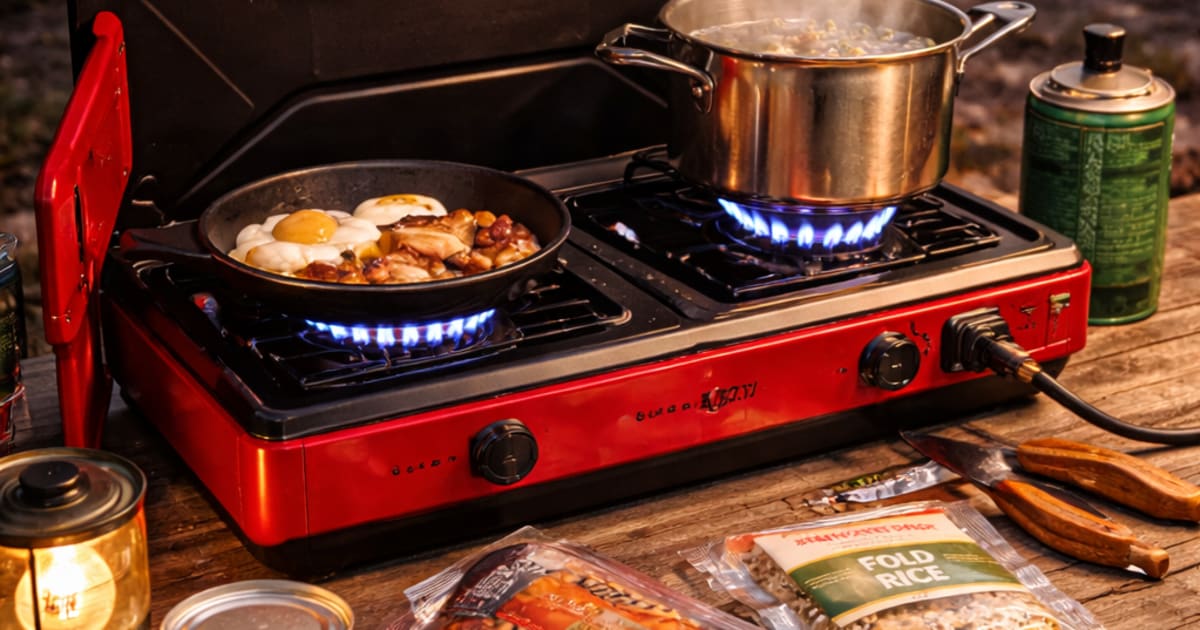
1. Camp Chef Everest 2X — Best Overall Portable Propane Stove
Best for: Families, extended outages, high-output cooking
The Camp Chef Everest 2X consistently ranks as one of the highest-rated emergency stoves available. Its dual burners deliver 20,000 BTUs each — enough to bring a full pot of water to a boil in under four minutes. The matchless ignition eliminates the need for lighters or matches, and the wind-resistant burners maintain consistent flame even in outdoor conditions.
Key Features:
- 40,000 BTU total output across two independent burners
- Matchless ignition — no additional fire-starting tools needed
- Fits standard 1-pound propane canisters or connects to larger 20-pound tanks via adapter
- Folding side shelves for workspace
- Compatible with a wide range of standard cookware
👉 Check Price on Amazon — Camp Chef Everest 2X
2. Coleman Classic Propane Stove — Best Budget Emergency Stove
Best for: Budget-conscious households, short-term outages, beginners
The Coleman Classic has been the benchmark affordable camp stove for decades. Reliable, straightforward, and widely available, it runs on the same 1-pound green propane canisters sold at virtually every hardware and sporting goods store. Two adjustable burners handle simultaneous cooking tasks without the complexity or cost of premium options.
Key Features:
- 20,000 BTU total output
- Wind protection panels on three sides
- Fits standard 1-pound propane canisters
- Adjustable, independent burner controls
- Compact fold-flat design for storage
👉 Check Price on Amazon — Coleman Classic Propane Stove
3. MSR PocketRocket 2 — Best Ultralight Single-Burner Stove
Best for: Bug-out bags, solo preppers, rapid boiling
The MSR PocketRocket 2 is a single-burner stove that weighs under 3 ounces and collapses to the size of a small flashlight. It screws directly onto standard isobutane-propane canisters and delivers 8,000 BTUs — enough to boil a liter of water in about 3.5 minutes. This is the stove for your bug-out bag or vehicle emergency kit where space and weight are critical.
Key Features:
- Weighs 2.6 oz — the lightest option in this guide
- Serrated pot supports prevent cookware slipping
- Precise simmer control for actual cooking, not just boiling
- Folds inside most MSR fuel canisters for transport
- 4-season performance including cold weather
👉 Check Price on Amazon — MSR PocketRocket 2
4. Solo Stove Lite — Best Wood-Burning Rocket Stove

Best for: Long-term scenarios, zero fuel cost, rural preppers
When stored fuel canisters run out, the Solo Stove Lite keeps cooking. This double-wall combustion system creates a secondary burn of gases, dramatically reducing smoke and maximizing heat from small sticks, pinecones, and bark. No fuel to stockpile, no canisters to expire — your fuel source is nature.
Key Features:
- Runs entirely on natural biomass — sticks, twigs, bark, pinecones
- Double-wall secondary combustion for almost smokeless operation
- Ultra-efficient — boils water with a handful of sticks
- Stainless steel construction, virtually indestructible
- Nests inside a medium cooking pot for compact storage
👉 Check Price on Amazon — Solo Stove Lite
5. Iwatani Cassette Fū Butane Stove — Best Indoor-Safe Option
Best for: Apartment dwellers, short-term indoor cooking, elderly households
The Iwatani cassette stove is the closest thing to a normal stovetop experience during a power outage. Running on butane cassette canisters, it delivers 10,000 BTUs through a wide burner that accommodates standard pots and pans up to 10 inches wide. The cassette format means no screw connections or adapters — fuel snaps in with one click.
Key Features:
- 10,000 BTU output — suitable for most everyday cooking
- Wide burner accommodates standard household cookware
- Wind guard on all sides
- Cassette fuel format — no threading, just click-and-cook
- Compact enough to store in a kitchen cabinet
👉 Check Price on Amazon — Iwatani Cassette Butane Stove
⚠️ Safety Note: Even butane stoves produce carbon monoxide. Always ensure adequate ventilation when cooking indoors. Never use propane stoves indoors under any circumstances.
6. Stansport Portable Propane Infrared Stove — Best for Rapid Boiling
Best for: Households prioritizing speed, freeze-dried meal prep
Infrared burner technology transfers heat more efficiently than traditional open-flame burners. This translates to faster boil times — critical when you're preparing freeze-dried meals from your emergency food pantry or purifying water from a filtration system.
Key Features:
- Infrared ceramic burner — faster, more efficient heat transfer
- Single-burner design — compact and lightweight
- Wind resistance superior to open-flame alternatives
- Runs on standard 1-pound propane canisters
👉 Check Price on Amazon — Stansport Propane Infrared Stove
7. GoSun Sport Solar Cooker — Best Zero-Fuel Emergency Cooker
Best for: Sunny climates, long-term preparedness, fuel-free cooking
The GoSun Sport uses concentrated sunlight to cook inside a vacuum-insulated glass tube. No flame, no fuel, no fire risk — just sunlight. On a clear day it reaches cooking temperatures of 550°F within minutes. It bakes, boils, steams, and fries using nothing but solar energy. An extraordinary long-term backup when all other fuel sources are depleted.
Key Features:
- Reaches 550°F using sunlight alone
- Cooks a full meal in 20–30 minutes on clear days
- No fuel, no smoke, no fire risk
- Works in temperatures as low as -40°F if sun is present
- Vacuum tube design retains heat for retained cooking
👉 Check Price on Amazon — GoSun Sport Solar Cooker
Emergency Stove Comparison Table
| Stove | Fuel Type | BTU Output | Best For | Indoor Safe? | |---|---|---|---|---| | Camp Chef Everest 2X | Propane | 40,000 | Families, extended outages | No | | Coleman Classic | Propane | 20,000 | Budget, short-term | No | | MSR PocketRocket 2 | Isobutane | 8,000 | Bug-out bags, solo | No | | Solo Stove Lite | Wood/biomass | Variable | Long-term, zero fuel | No | | Iwatani Cassette | Butane | 10,000 | Apartments, indoor use | With ventilation | | Stansport Infrared | Propane | 15,000 | Speed, freeze-dried meals | No | | GoSun Sport | Solar | N/A | Sunny climates, fuel-free | Yes |
How to Choose the Right Fuel for Your Emergency Stove
Choosing the right stove is only half the equation. Your fuel strategy determines how long your cooking capability lasts.
Propane (1-lb Canisters)
The most widely available emergency fuel in the United States. Sold at hardware stores, grocery stores, and gas stations. Burns cleanly, performs well in cold temperatures, and stores indefinitely when sealed. Stock a minimum of 12 canisters — enough for one month of basic cooking at one canister per 2.5 days of use.
Isobutane-Propane Blends (Backpacking Canisters)
Higher performance than standard propane in cold conditions. More expensive and less widely available. Best reserved for bug-out bags and backpacking scenarios where weight savings matter.
Butane Cassettes
Widely available, inexpensive, and convenient. Butane performs poorly below 32°F, making cassette stoves a warm-weather or indoor solution rather than a four-season option.
White Gas & Dual-Fuel
The highest performance liquid fuel option. Burns hotter than any canister fuel, re-fuels from standard gasoline in an emergency, and performs reliably in extreme cold. Requires more maintenance and careful handling than canister fuels.
Wood & Biomass
Infinite availability in most geographic regions. No storage cost, no expiration date. Requires more skill to manage than canister fuel and produces more smoke. The best long-term fuel option when all stored supplies are depleted.
Pro Tip: Don't rely on a single fuel source. Stock a primary canister stove with 2–3 weeks of fuel, a wood-burning backup stove, and purification tablets as a final safety net. Redundancy is the cornerstone of serious emergency preparedness.
Essential Cooking Gear Beyond the Stove
A stove without the right supporting equipment creates frustration in the field. These items complete your emergency cooking kit.
Lightweight Cookware Set — A nesting pot and pan set rated for open-flame use. Avoid non-stick coatings that degrade at high heat. Stainless steel or hard-anodized aluminum are the most durable choices.
👉 Check Price on Amazon — Camping Nesting Cookware Set
Jetboil Flash Cooking System — An all-in-one boiling system that integrates stove, fuel canister, and cooking cup into one unit. The fastest boil time of any canister solution — 100 seconds per liter. Purpose-built for freeze-dried meal preparation.
👉 Check Price on Amazon — Jetboil Flash Cooking System
Manual Can Opener — Non-negotiable. Electric can openers are useless without power. Every emergency kit needs at least two manual can openers stored separately.
👉 Check Price on Amazon — Swing-A-Way Manual Can Opener
Long-Stem Lighter — A windproof, refillable lighter with an extended stem for safe stovetop ignition. Far more reliable than disposable lighters in cold or wet conditions.
👉 Check Price on Amazon — Zippo Flex Neck Utility Lighter
Collapsible Silicone Kettle — A lightweight, packable kettle purpose-built for boiling water — critical for rehydrating freeze-dried meals, making coffee, and basic sanitation.
👉 Check Price on Amazon — Collapsible Silicone Camping Kettle
No-Cook Emergency Meal Strategies
The smartest emergency food plan doesn't rely entirely on cooking. These no-cook options eliminate fuel dependency for a significant portion of your daily calories.
Ready-to-Eat (RTE) Foods: Canned beans, tuna, sardines, and chicken require zero preparation and deliver complete protein. Eat directly from the can — no heat, no water, no cookware.
Energy Bars & Survival Rations: High-calorie emergency food bars deliver 2,400 to 3,600 calories per package with no preparation. Coast Guard-approved options are the benchmark for caloric density and shelf life.
Trail Mix, Nuts & Dried Fruit: Calorically dense, shelf-stable, and entirely ready to eat. A mixture of nuts, seeds, and dried fruit provides carbohydrates, protein, fat, and micronutrients without any preparation.
Peanut Butter: One of the most calorie-dense shelf-stable foods available. 190 calories per two tablespoons, no refrigeration required, and palatable eaten directly from the jar.
For a complete breakdown of which emergency foods require cooking versus which are ready to eat, see our Best Emergency Food Kits for Survival (2026) guide.
Off-Grid Cooking Safety — Critical Rules
Emergency cooking introduces real safety risks that routine kitchen use does not. Follow these non-negotiable guidelines from the CDC and American Red Cross
Carbon Monoxide Is Invisible and Deadly: Propane, butane, white gas, and charcoal all produce carbon monoxide during combustion. Never use any of these fuel sources indoors, in garages, or in enclosed spaces without strong cross-ventilation. Carbon monoxide poisoning kills without warning.
Fire Separation: Keep your stove on a stable, non-combustible surface at least three feet from any structure, fabric, or flammable material.
Fuel Storage: Store all fuel canisters outside the living space in a cool, well-ventilated area away from direct sunlight and heat sources. Never store fuel canisters inside a home or vehicle.
Supervision: Never leave a lit stove unattended, especially with children or pets nearby.
Extinguisher Access: Keep a fire extinguisher within arm's reach of your cooking area at all times. This should already be part of your home emergency plan.
Building Your Complete Emergency Cooking System
A complete off-grid cooking setup for a family of four requires layered redundancy across multiple fuel types and cooking methods.
Layer 1 — Primary Stove: Camp Chef Everest 2X or Coleman Classic with 12+ propane canisters. Handles 80% of your cooking for the first 30 days.
Layer 2 — Bug-Out Stove: MSR PocketRocket 2 with 6 isobutane canisters stored in your bug-out bag. Handles mobile cooking if you have to evacuate.
Layer 3 — Long-Term Backup: Solo Stove Lite for fuel-free cooking when canisters run out. Pairs with water filtration and food storage for indefinite self-sufficiency.
Layer 4 — No-Cook Reserve: Minimum 3-day supply of ready-to-eat foods that require zero cooking, heating, or water. This is your safety net when every other layer is unavailable.
Visit our Power & Energy Solutions and Food & Nutrition categories to complete your preparedness system.
Final Thoughts
Emergency cooking preparedness is the logical next step after securing your power, water, and food supplies — and the step most households skip. The generators are ready. The water is stored. The pantry is stocked.
Now make sure you can actually use it.
A reliable portable stove, a diversified fuel supply, and a selection of no-cook ready-to-eat foods transform a reactive emergency response into a calm, functional household operation. Your family eats well. Morale stays high. Stress stays low.
That is what real preparedness looks like.
Explore our complete Emergency Kits & Bundles and Shop All Survival Gear to build your full system today.
⚠️ Don't wait until it's too late — get prepared now. Every day without a plan is a risk. Most people wish they had prepared sooner. Start today.