A bug out bag — also called a go bag, BOB, or 72-hour kit — is a pre-packed backpack containing everything you need to survive independently for at least 72 hours if you're forced to evacuate your home without warning.
FEMA recommends every household maintain a ready-to-go emergency kit. The difference between a grab-and-go bag and a standard emergency kit is portability — your bug out bag needs to be ready to grab in seconds and carry on your back.
This guide covers every essential item your bug out bag needs in 2026, organized by category, with specific gear recommendations for every budget.

What Is a Bug Out Bag?
A bug out bag is a portable emergency survival kit designed for rapid evacuation. You grab it when disaster strikes — hurricane, earthquake, wildfire, flooding, civil unrest — and you need to leave immediately.
The rule of thumb: your pack should sustain one person for 72 hours minimum. FEMA's research shows the first 72 hours after a major disaster are when government response is slowest and self-sufficiency matters most.
According to Red Cross, every household should have an emergency kit ready at all times.
The Complete Bug Out Bag Checklist for 2026
1. The Bag Itself
Your bag is the foundation of your entire kit. Choose wrong and everything else suffers.
What to look for:
- 40–72L capacity for a full 72-hour kit
- MOLLE webbing for attaching extra pouches
- Padded shoulder straps and sternum strap
- Hydration bladder sleeve
- Water-resistant or waterproof fabric
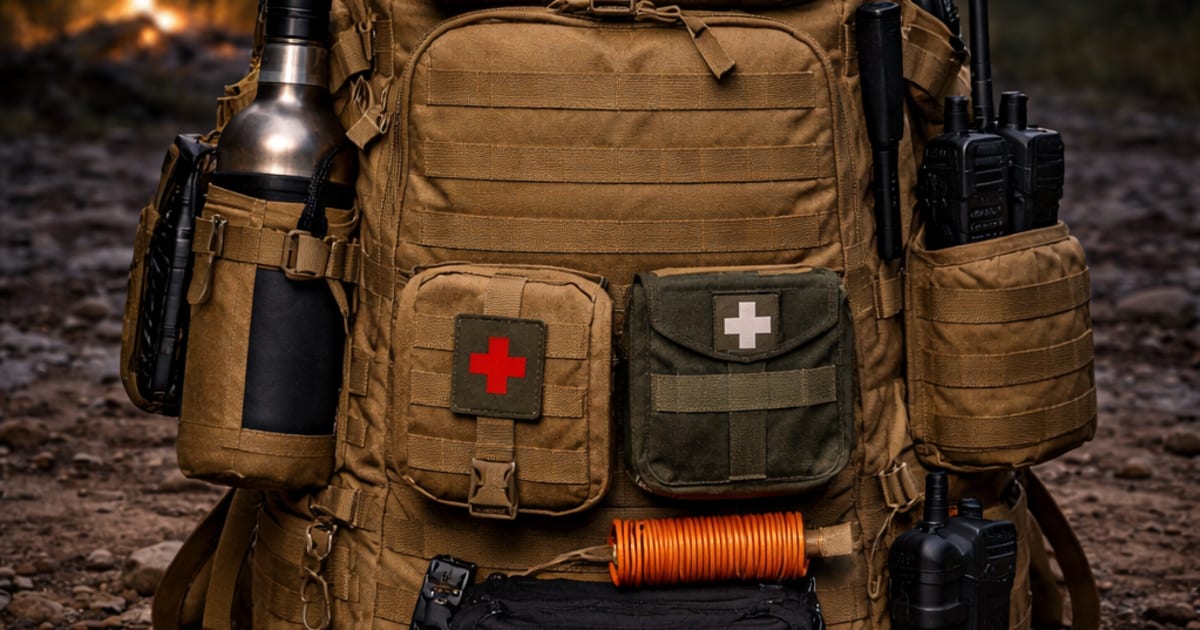
Our top picks:
- 72L Tactical Backpack — maximum capacity for serious preppers
- 50L Tactical MOLLE Backpack — best balance of size and weight
- Jueachy Tactical Backpack — best budget pick, Amazon top seller
2. Water & Hydration
You can survive about 3 weeks without food but only 3 days without water. Therefore, water is your #1 priority.
Minimum: 1 liter of water per person per day plus a filtration method for resupply.
What to pack:
- Water purification tablets — lightweight backup that fits in any pocket
- Personal water filter — filters up to 1,000 gallons from any source
- Collapsible water containers — store flat, expand when needed
- Hydration bladder — hands-free drinking on the move
- Electrolyte packets — replace minerals lost through sweat and stress
For a deeper breakdown of the best purification systems, portable filters, and long-term water storage strategies, read our Best Water Filtration Systems for Survival and Best Emergency Water Storage Solutions.

Our top picks:
- LifeStraw Personal Water Filter — filters 99.9% of bacteria and parasites
- Water Purification Tablets — backup that weighs nothing
- Electrolyte Powder Packs — critical for sustained physical exertion
3. Food & Nutrition
Your bug out bag food supply needs to be lightweight, calorie-dense, require no cooking, and have a long shelf life.
Minimum: 1,800–2,400 calories per person per day for 3 days.
What to pack:
- Emergency food bars — 3,600 calories per pack, no preparation needed
- MRE meals — complete meals with flameless heaters
- Freeze-dried meals — lightweight with 25-year shelf life
- Protein bars — quick energy, no preparation
- Trail mix — calorie-dense, no preparation needed
If you are building a larger emergency food supply beyond your bug out bag, see our guides on Best Emergency Food Kits for Survival and How to Build a Long-Term Emergency Food Storage Pantry.

Our top picks:
- 3600 Calorie Emergency Food Bars — Coast Guard approved, works in any conditions
- Military-Style MRE Meal Packs — complete meals, no water needed
- Backpacking Meal Pouches — lightest option for long-distance evacuation
4. Shelter & Warmth
Exposure kills faster than hunger or thirst. Your bug out bag must contain the means to stay dry and warm in any weather.
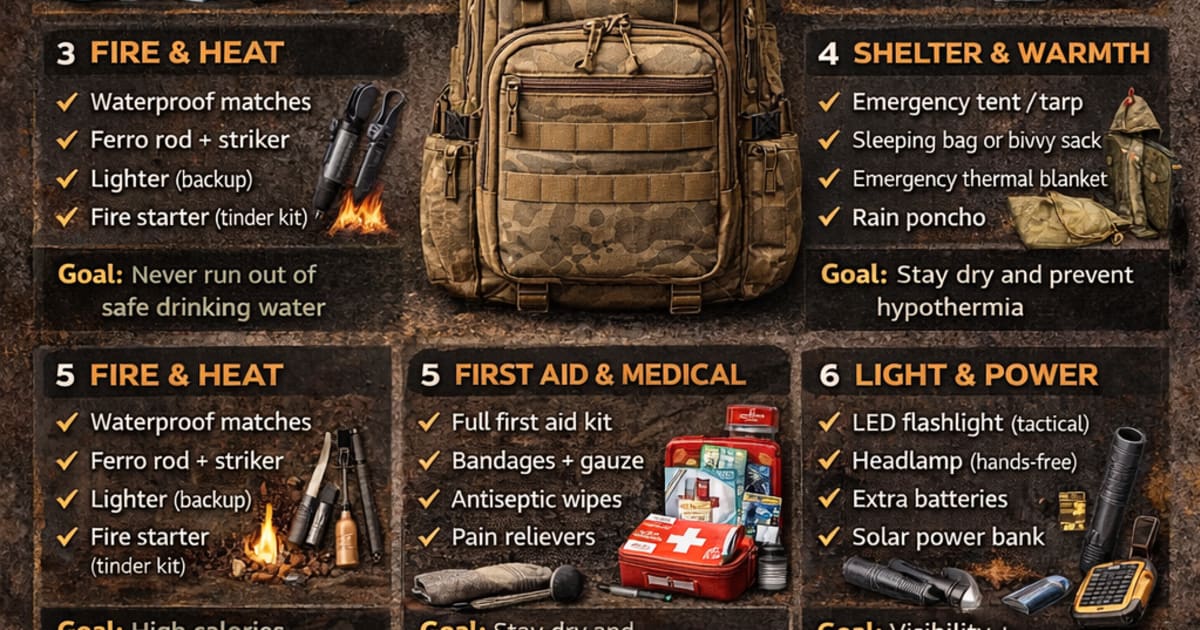
What to pack:
- Emergency mylar blanket — reflects 90% of body heat, weighs 2oz
- Emergency bivvy sack — reusable, full-body warmth
- Waterproof rain poncho — covers you and your pack
- Emergency tarp — shelter construction, ground cover, rain collection
- Hand warmers — critical for cold-weather emergencies
Our top picks:
- Emergency Bivvy Sack — best overall emergency shelter, reusable
- Heavy-Duty Mylar Emergency Blankets — pack one for every family member
- Hand Warmers 40-Pack — 10 hours of warmth per pair
5. First Aid & Medical
Medical emergencies are among the most common scenarios in any disaster. Your bug out bag first aid kit must go beyond basic bandages.
What to pack:
- Trauma-grade first aid kit — tourniquet, Israeli bandage, hemostatic gauze
- CAT tourniquet — stop life-threatening limb bleeding in seconds
- Personal prescription medications — 7-day minimum supply
- OTC medications — pain relievers, antihistamines, anti-diarrheal
- CPR face shield — remove barriers to immediate action
Medical preparedness becomes even more important during long-term disasters when emergency services may be delayed or unavailable. Our guides on Best First Aid Kit for Emergency Preparedness and What to Do If Someone Gets Hurt and Help Is Hours Away cover advanced emergency medical planning in detail.

Our top picks:
- IFAK Trauma Kit — military-grade, covers life-threatening injuries
- CAT Tourniquet — gold standard, one-handed application
- Compact Personal First Aid Kit — 125-piece waterproof hard case
6. Fire Starting
Fire provides warmth, purifies water, signals rescuers, and dramatically improves morale. Always carry at least two fire-starting methods.
What to pack:
- Ferro rod — thousands of strikes, works wet and cold
- Waterproof matches — backup ignition
- Windproof lighter — easiest to use under stress
- Tinder kit — guaranteed ignition material
Our top picks:
- Ferro Rod & Striker Set — 5,500°F sparks in any weather
- Emergency Fire Starter Kit — everything in one waterproof case
7. Navigation & Communication
When cell towers are down and GPS is unavailable, you need analog navigation and communication tools.
What to pack:
- Hand crank NOAA weather radio — stay informed of developing conditions
- Baseplate compass — navigate without batteries
- Waterproof topographic maps — your region's terrain in detail
- Emergency whistle — 120dB signal audible over a mile
- Signal mirror — visible up to 10 miles in sunlight
Communication systems often fail during large-scale disasters and power outages. Our guides on Best Hand Crank Emergency Radio and Best Off-Grid Communication Devices for Emergencies and Bug Out Situations explain how to stay informed when traditional systems go offline.

Our top picks:
- Midland ER310 Hand Crank Emergency Radio — solar, hand crank, NOAA alerts, phone charging
- Suunto A-10 Field Compass — trusted by military navigators
- Fox 40 Emergency Whistle — pealess, works wet, 120dB
8. Tools & Multi-Use Gear
A quality multitool and a few essential items dramatically expand your capability in the field.
What to pack:
- Full-size multitool — pliers, knife, screwdrivers, wire cutters
- Fixed blade knife — bushcraft, food prep, shelter building
- Paracord — 100 feet minimum, infinite uses
- Duct tape — repairs, improvised shelter, first aid
- Folding shovel — latrine digging, vehicle extraction
Our top picks:
- Leatherman Wave+ Multitool — the gold standard multitool
- Morakniv Companion Fixed Blade — best value survival knife
- 550 Paracord 100ft — mil-spec, 550lb test
9. Power & Lighting
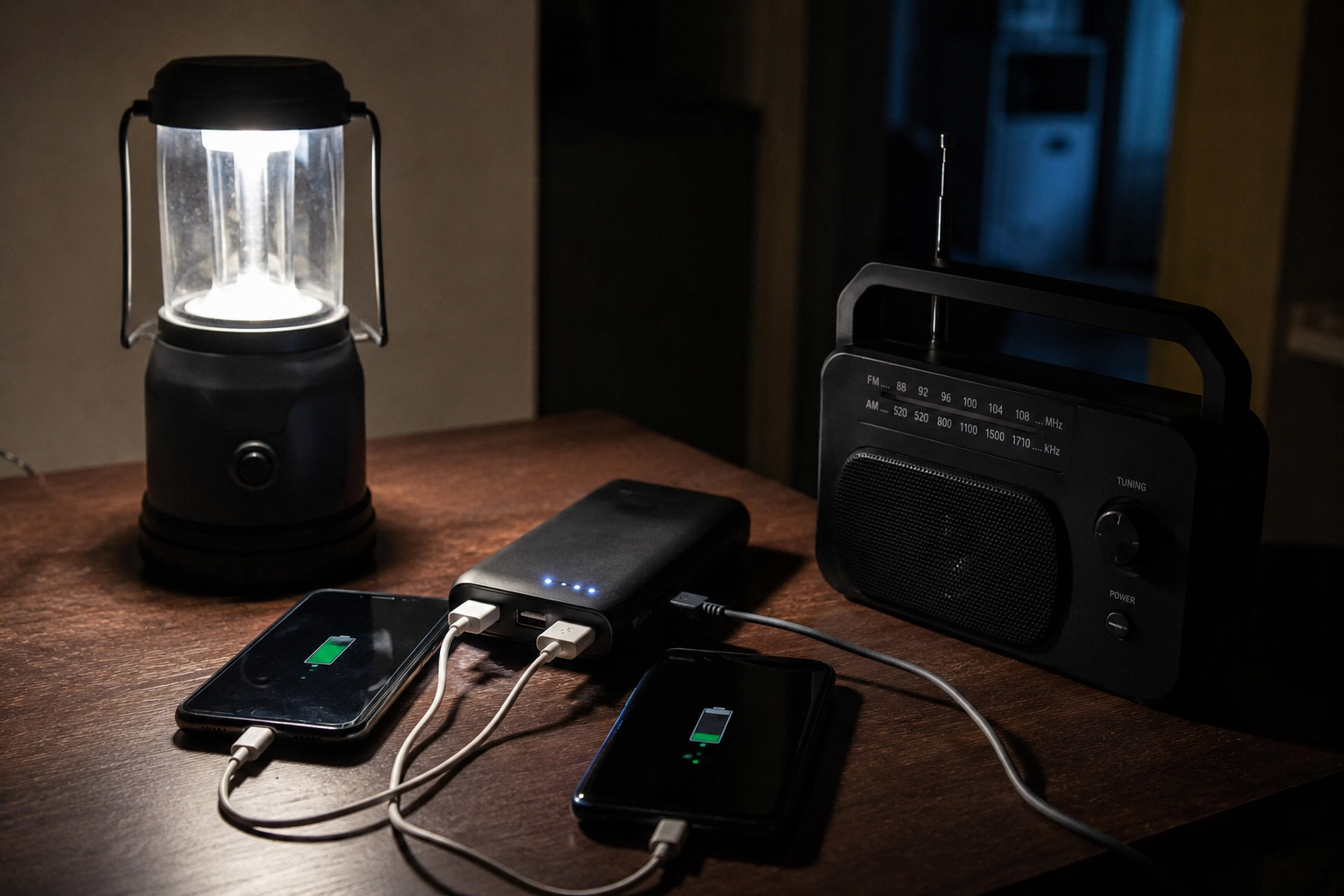
Lighting and emergency power are critical for nighttime operations and communication.
Reliable backup power and emergency lighting are critical during blackouts and evacuations. For larger backup systems and long-term emergency power planning, see our guides on Best Solar Generators & Power Stations for Emergencies and Best Tactical Flashlights and Headlamps for Power Outages.
What to pack:
- Headlamp — hands-free lighting for any task
- Solar power bank — recharge devices off-grid
- Backup batteries — power for flashlights and radios
- Chemical light sticks — no batteries, waterproof
Our top picks:
- Black Diamond Spot 400 Headlamp — 400 lumens, waterproof
- 30,000mAh Solar Power Bank — charges phones 6–8 times
- Eneloop Pro Rechargeable Batteries — 500 recharge cycles
10. Documentation & Cash
In a real emergency, documentation and cash are as important as any piece of gear.
What to pack:
- Waterproof document pouch — IDs, insurance cards, emergency contacts
- USB drive — digital copies of all documents
- $200–$500 cash in small bills — ATMs go offline immediately
- Written emergency contact list — when phones die, you need this
Bug Out Bag Weight Guidelines
Weight is the most overlooked factor in bug out bag planning:
| Body Weight | Max Bag Weight | |---|---| | 120 lbs | 30 lbs | | 150 lbs | 37.5 lbs | | 180 lbs | 45 lbs | | 200 lbs | 50 lbs |
Rule: Never carry more than 25% of your body weight.
Additional Bug Out & Emergency Preparedness Guides
Building a bug out bag is only one part of complete emergency preparedness. These additional guides will help you prepare for longer emergencies, power outages, and grid down scenarios:
- How to Start Prepping for Beginners in 2026
- Beginner Survival Guide (2026): 15 Essential Tips to Stay Prepared
- Why Every Family Needs an Emergency Plan
- Complete Grid Down Survival Guide (2026)
- How to Prepare Your Home for a Power Outage in 7 Days
Quick Reference Bug Out Bag Checklist
Water & Hydration
- [ ] Water (1L minimum)
- [ ] Water filter
- [ ] Purification tablets
- [ ] Collapsible containers
Food
- [ ] Emergency food bars (3,600 cal)
- [ ] MREs or freeze-dried meals
- [ ] Utensils
Shelter
- [ ] Emergency bivvy
- [ ] Mylar blankets
- [ ] Rain poncho
- [ ] Paracord
Medical
- [ ] IFAK trauma kit
- [ ] CAT tourniquet
- [ ] Personal medications
Fire
- [ ] Ferro rod
- [ ] Waterproof matches
- [ ] Lighter
Navigation
- [ ] Compass
- [ ] Maps
- [ ] Emergency radio
- [ ] Whistle
Tools
- [ ] Multitool
- [ ] Fixed blade knife
- [ ] Duct tape
Power & Lighting
- [ ] Headlamp + batteries
- [ ] Power bank
Documents
- [ ] ID copies
- [ ] Cash
- [ ] Emergency contacts
For the complete gear breakdown, visit our Bug Out Bags category.
Related Reading:
I Put My ZIP Code Into the Grid Down Simulator — Here's What It Told Me About My Risk
I Tested My Home in a Grid-Down Scenario — Here's What Happened
What Happens If the Power Grid Goes Down? A Step-by-Step Survival Timeline